
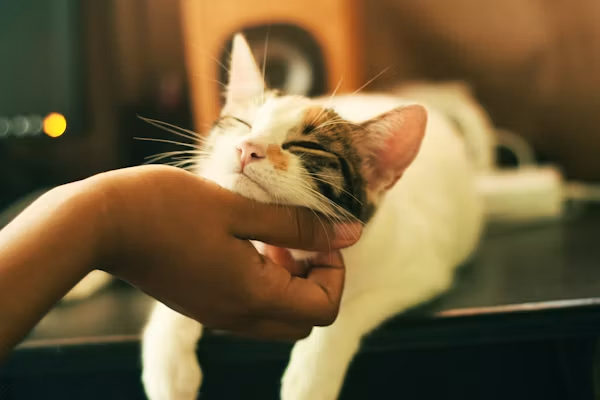
You are sitting quietly on the couch when your cat walks over, settles beside you, and suddenly starts licking your hand. Maybe it is your arm, your face, or even your hair. At first, it can feel sweet. Then the licking continues, and you start wondering: why does my cat lick me?
Cats have many ways of communicating, and licking is one of the behaviors that can leave their humans especially curious. It can look like affection, grooming, or simply a strange feline habit.
The truth is that there is not always one single explanation. Cats may lick people for several reasons, and the meaning often depends on what is happening around the behavior.
In many cases, licking is connected to social bonding. Cats groom members of their social group, and some cats extend this behavior to the humans they trust. But licking can also be a way to get attention, investigate an interesting taste or smell, or seek comfort.
Here are some of the most common reasons your cat may be licking you.
1. Your Cat May Be Showing Affection
One of the simplest explanations is that your cat is expressing affection.
Cats do not always show attachment in the same ways humans do. A cat may choose to sit beside you, rub against your legs, follow you around the house, or groom you.
Grooming is an important social behavior among cats. Mothers groom their kittens, and cats that have a close relationship may groom one another. This behavior, known as social grooming or allogrooming, can help strengthen social bonds.
When your cat licks you, it may be treating you as part of its social group.
That does not necessarily mean your cat is thinking about affection in exactly the same way you are. But the behavior can be a sign that your cat feels comfortable and socially connected to you.
2. Your Cat May Be Grooming You
Your cat may genuinely be trying to groom you.
From your cat’s perspective, licking is a normal part of feline behavior. Cats spend a significant amount of time grooming themselves, and they may also groom cats with whom they have a social bond.
So when your cat licks your arm or hand, it may be performing a behavior that feels completely natural to them.
You might not need grooming in the feline sense, but your cat does not necessarily know that.
This can be especially noticeable when your cat is already relaxed beside you. A quiet moment on the couch can turn into a little grooming session simply because your cat is comfortable and interacting with someone it considers familiar.
3. Your Cat May Be Trying to Get Your Attention
Sometimes the explanation is much simpler.
Your cat may have discovered that licking you gets a reaction.
Perhaps you pet your cat when it licks you. Maybe you talk to it, laugh, move your hand, or look directly at it.
From your cat’s point of view, the important part is that licking produces interaction.
Cats can learn through repetition. If a particular behavior consistently results in attention, they may continue using it.
This is one reason your cat might suddenly start licking you when you are working, watching television, or doing something that does not involve them.
It may simply be saying, in its own feline way, “Pay attention to me.”
4. Your Cat May Like the Taste or Smell of Your Skin
Sometimes your cat may lick you because you taste interesting.
Human skin can contain traces of sweat, salt, oils, food, or scented products. Your cat’s sense of smell is much more sensitive than yours, so something that seems completely uninteresting to you may be worth investigating to your cat.
This can explain why some cats seem particularly interested in licking hands, arms, or areas of skin after a person has been outside or exercising.
However, there is an important reason not to encourage your cat to lick skin covered with certain products.
Lotions, creams, medications, essential oils, and other topical products can contain ingredients that are unsafe for cats. If your cat becomes interested in licking your skin after you apply a product, it is better to prevent the licking and check whether the product is safe around pets.
5. Your Cat May Be Seeking Comfort
Licking can also have a comforting quality for some cats.
Kittens experience grooming from their mothers from a very young age. Some adult cats retain behaviors associated with kittenhood, particularly when they are relaxed or seeking comfort.
You may notice licking accompanied by other behaviors such as kneading or purring.
If your cat curls up beside you, kneads a blanket, purrs, and starts licking you, the entire interaction may be part of a familiar comfort routine.
It can be one reason some cats become especially affectionate during quiet moments, bedtime, or when they are settling down.
6. Your Cat May Be Mixing Scents With You
Scent is extremely important to cats.
Cats use scent as part of how they understand their environment and recognize familiar members of their social group. Licking may contribute to this social exchange of scent.
Your cat may also rub its face against you, sleep beside you, or groom you as part of a broader pattern of familiar interaction.
Rather than thinking of licking only as “kissing,” it can be more useful to think of it as one part of your cat’s communication system.
Your cat is interacting with you in a distinctly feline way.
7. Why Does My Cat Lick Me So Much?
If you are wondering why does my cat lick me so much, the answer depends on what “so much” means.
Some cats are simply more interested in grooming and physical interaction than others.
If your cat has always licked you frequently and otherwise appears relaxed, eats normally, plays, sleeps, and behaves as usual, the licking may simply be part of its personality and social behavior.
But a sudden change is worth noticing.
If your cat suddenly becomes much more focused on licking you, objects, or itself, look for other changes in behavior. Stress can sometimes lead to repetitive licking, and medical problems can also cause changes in grooming behavior.
The important thing is not to judge the behavior by the number of licks alone. Look at the whole picture.
8. Why Does My Cat Keep Licking Me?
A cat that repeatedly returns to lick you may have learned that the behavior creates interaction.
It may also simply enjoy the social contact.
Pay attention to what happens immediately before and after the licking.
Does your cat come to you when you stop petting it? Does it lick you and then settle down beside you? Does it lick you before asking for food? Does it lick you when you are preparing to go somewhere?
These details can give you clues about what the behavior means for your particular cat.
Cats develop individual routines with their humans, so context matters.
9. Why Does My Cat Lick My Face?
The face is a particularly interesting target because cats often groom around the head and face when interacting socially.
Your cat may lick your face as an extension of grooming behavior, affection, attention-seeking, or simple curiosity.
However, you do not have to allow it if you dislike the sensation.
If you want to discourage face licking, calmly move your face away and redirect your cat toward another form of interaction, such as petting or play. Avoid turning the moment into a dramatic reaction, because even negative attention can sometimes reinforce a behavior that your cat has learned gets a response.
10. Why Does My Cat Lick Me and Then Bite Me?
This combination can be confusing.
One moment your cat is licking your hand, and the next there is a little bite.
A gentle bite does not automatically mean your cat has suddenly become aggressive. Cats can become overstimulated during physical interaction, and licking may be followed by biting when they have had enough contact.
Context is important.
Watch your cat’s body language. Changes in tail movement, ear position, body tension, or attempts to move away can indicate that your cat is becoming uncomfortable.
If you notice this pattern frequently, it is worth paying attention to what happens immediately before the bite.
And if the bite is painful, aggressive, or accompanied by a sudden change in your cat’s behavior, speak with a veterinarian or qualified behavior professional.
When Should You Be Concerned About Your Cat’s Licking?
Occasional licking is generally a normal feline behavior.
The situation is different when licking becomes excessive, compulsive, or suddenly changes.
Veterinary sources recommend paying attention to unusual changes in licking or grooming, especially when they occur alongside other signs of illness, pain, anxiety, or behavioral change.
You should consider contacting your veterinarian if your cat’s behavior changes suddenly or if you notice other concerning symptoms.
The goal is not to assume that every unusual lick means something is wrong. It is simply to notice when your cat’s normal pattern has changed.
So, Why Does Your Cat Lick You?
So, why does my cat lick me?
There may be several answers.
Your cat may be showing affection, grooming you as part of its social behavior, looking for attention, investigating your scent or taste, seeking comfort, or simply repeating a behavior that has become part of your relationship.
In many cases, licking is one small piece of a much larger picture.
Look at what your cat does before and after the licking. Does your cat purr? Knead? Rub against you? Curl up beside you? Follow you around the house?
Those behaviors together can tell you much more than the licking alone.
And perhaps that is the most interesting thing about living with a cat: they rarely communicate with just one signal.
Sometimes the rough little tongue on your hand is simply your cat’s way of saying that you are familiar, safe, interesting, and worth staying close to.