
You look up from your phone and notice your cat sitting across the room, quietly staring at you.
You look away for a moment. When you look back, those eyes are still fixed on you.
It can be adorable. It can also be a little strange.
Cats have a way of watching us that makes it feel as though they know exactly what we are thinking. Sometimes they stare while sitting peacefully on the couch. Other times, they watch us from the hallway, from the foot of the bed, or even from across the room while we are eating.
So, why does my cat stare at me?
The answer depends on what your cat is doing with the rest of its body. A stare can be a request for attention, a sign of curiosity, an invitation to play, a way of asking for food, or even a sign that your cat feels uncomfortable.
Learning to read the entire body language behind the stare can help you understand what your cat is actually trying to communicate.
1. Your Cat Wants Your Attention
One of the most common reasons a cat may stare at you is surprisingly simple: your cat wants you to notice them.
Cats quickly learn which behaviors make their humans respond. If staring at you usually leads to petting, talking, playing, or getting up to see what they want, your cat may repeat the behavior.
You may notice this especially when you are busy doing something else.
Your cat sits nearby.
You continue working.
Your cat stares.
Eventually, you look over.
That moment of eye contact may be exactly what your cat was waiting for.
Some cats will follow the stare with a meow, a rub against your legs, or a slow blink. These additional behaviors can give you more information about what they want.
2. Your Cat May Be Hungry
If your cat starts staring at you around mealtime, there may be a very practical explanation.
Your cat may be asking for food.
Cats are excellent at learning routines. If breakfast usually happens at 7 a.m., your cat may begin watching you as that time approaches. The same thing can happen before dinner or whenever your cat expects a treat.
You may also notice your cat staring at you while you are eating.
Sometimes the message is obvious: your cat wants whatever is on your plate.
That does not mean you should automatically share your food. Many human foods are not appropriate for cats, and maintaining a consistent diet is generally better than responding to every begging behavior.
Instead, look at the timing.
If the staring happens regularly just before your cat’s normal meal, hunger may explain the behavior.
3. Your Cat Is Curious About You
Cats are naturally observant animals.
They spend a lot of time watching their surroundings, and you are one of the most important things happening in their environment.
Think about how many unusual things you do from your cat’s perspective.
You open drawers.
You move objects.
You make strange sounds.
You walk from one room to another.
You suddenly sit down.
You pick up something your cat has never seen before.
Your cat may simply be watching because something has caught its attention.
This is especially likely if the stare is relaxed and your cat’s body looks comfortable.
A curious cat may sit upright, keep its ears oriented toward you, and watch what you are doing without showing signs of fear or tension.
Sometimes, there is no deeper mystery.
Your cat is simply interested in what you are doing.
4. Your Cat May Be Asking You to Play
A cat that stares at you while crouching, moving its tail, or becoming more alert may be trying to start a game.
Look at the rest of the body.
Are the pupils larger than usual?
Is the tail moving?
Is your cat crouched as if ready to spring?
Does your cat suddenly run toward you or toward a toy?
These signs can indicate that the stare is connected to play rather than affection or food.
Some cats have very obvious ways of asking for playtime. Others simply position themselves nearby and watch until their human finally gets the message.
If your cat seems playful, try offering an interactive toy rather than using your hands as a toy.
A short play session can provide both physical activity and mental stimulation.
5. Your Cat May Be Showing Affection
Not every stare is a demand.
Sometimes your cat may simply be looking at you because it feels safe and comfortable around you.
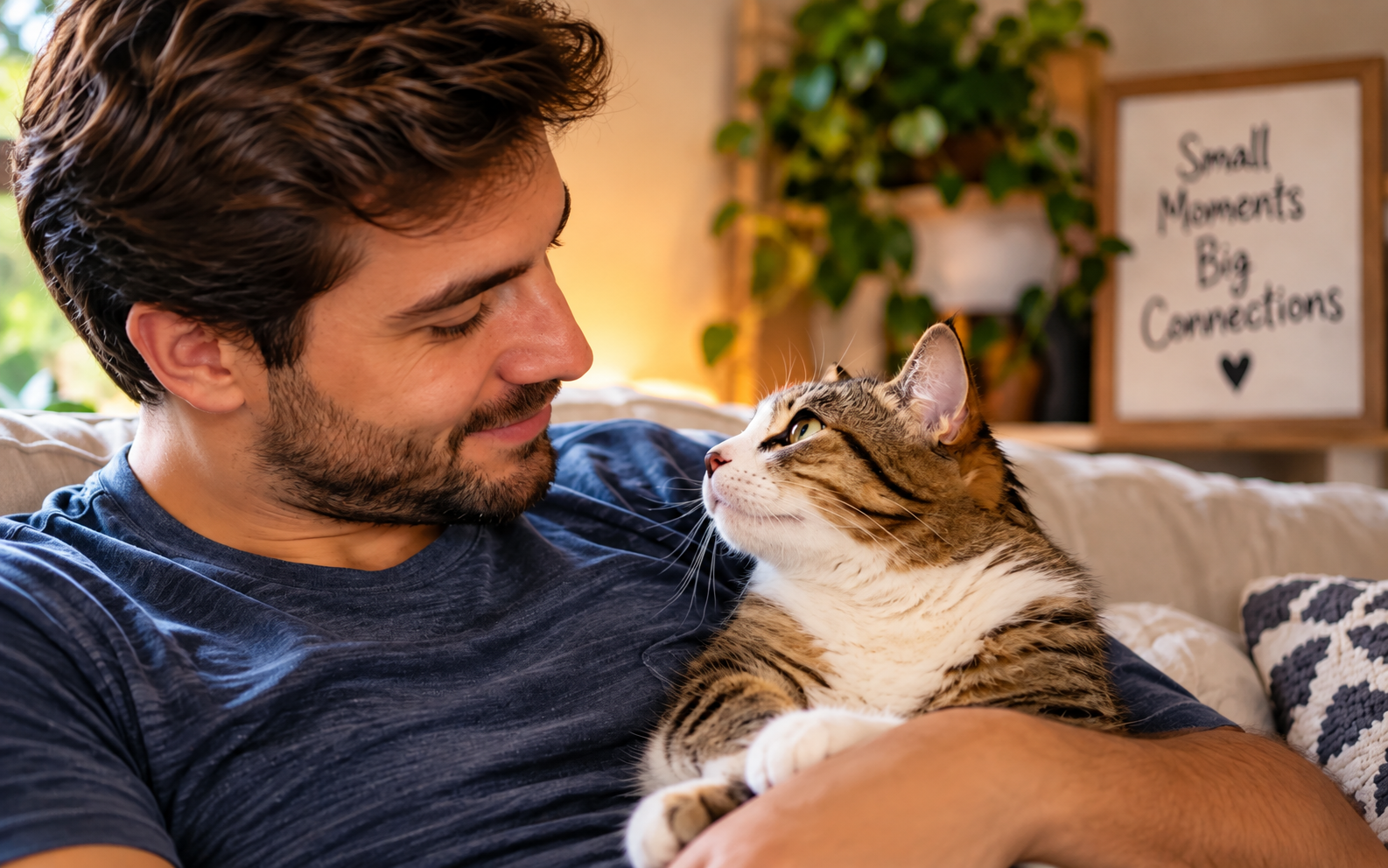
Cats can use eye contact as part of positive social interaction. One particularly important behavior is the slow blink. A relaxed gaze accompanied by slow blinking can be a sign of trust and positive social communication. Cats may also show affection in other ways, such as grooming you.
If your cat looks at you with relaxed eyes and slowly closes and opens them, that is very different from a hard, unblinking stare.
A relaxed gaze accompanied by slow blinking can be a sign of trust and positive social communication. Research and veterinary behavioral guidance commonly describe slow blinking as an affiliative behavior between cats and their trusted humans.
You can even try slowly blinking back.
Your cat may return the gesture.
It is one of those quiet moments that can make living with a cat feel surprisingly intimate.
6. Why Does My Cat Just Stare at Me?
Sometimes the question is even more specific:
Why does my cat just stare at me?
Your cat may not be asking for anything obvious.
There may be no meowing, no food bowl nearby, and no toy in sight.
In this situation, look at your cat’s overall posture.
If the body is relaxed, the ears are in a natural position, and the eyes look soft rather than intensely fixed, your cat may simply be observing you.
Cats do not always need to interact physically with their humans. They can enjoy being in the same space while quietly watching what is happening.
Your cat may be resting while keeping track of the most interesting person in the room: you.
7. Your Cat May Be Waiting for Something
Cats are creatures of habit.
Your cat may stare at you because it has learned that you are responsible for something that happens next.
Maybe you usually open the door at a certain time.
Maybe you fill the food bowl.
Maybe you give treats after finishing your coffee.
Maybe you play with your cat before bed.
Once cats learn a routine, they can become very good at anticipating it.
The stare can therefore be less about the present moment and more about what your cat expects to happen next.
If your cat watches you at approximately the same time every day, consider what usually happens immediately afterward.
You may discover that your cat has been reminding you about the schedule.
8. Your Cat May Be Feeling Nervous
A stare is not always friendly.
Sometimes cats stare because they are worried about something.
For example, your cat may become very focused on you after a sudden noise, an unfamiliar movement, a new person entering the room, or another situation that makes them uncertain.
In these situations, the eyes are only one part of the message.
A nervous cat may have dilated pupils, lowered its body, pulled its ears backward or sideways, or become unusually still.
If your cat looks frightened, give it space rather than approaching to pet it.
The goal is to understand what your cat is communicating, not to force an interaction.
9. A Hard Stare Can Mean “Give Me Space”
There is a major difference between a relaxed gaze and a hard, unblinking stare.
If your cat is staring intensely while its body is stiff, its ears are flattened or pulled back, its fur is raised, or it is growling or hissing, the message may be very different.
Your cat may be frightened, defensive, or warning you to back away.
In that situation, do not interpret the stare as affection.
Give your cat room.
Veterinary behavior guidance recommends looking at the complete body language rather than interpreting eye contact by itself. Signs such as stiff posture, dilated pupils, flattened ears, raised fur, growling, or hissing can indicate fear or aggression.
A cat that feels threatened needs distance, not more attention.
10. Why Does My Cat Stare at Me While I Sleep?
This is one of the behaviors that can feel particularly mysterious.
You wake up and discover your cat sitting nearby, staring at you.
There are several possible explanations.
Your cat may simply be awake while you are sleeping. Cats can be active during periods when humans are resting, and your movement may attract their attention.
Your cat may also be waiting for you to wake up because something in the normal routine is about to happen.
Perhaps breakfast is coming.
Perhaps your cat wants attention.
Perhaps it simply likes staying close to you.
If your cat is relaxed and behaving normally, there is usually no reason to assume that the stare has some mysterious meaning.
Your sleeping face is simply another interesting thing for your cat to observe.
What Your Cat’s Eyes Are Telling You
The eyes are important, but they should never be interpreted alone.
When your cat stares at you, ask yourself:
Are the eyes soft or intense?
Is your cat blinking slowly?
Are the pupils very large?
What are the ears doing?
Is the body relaxed or tense?
Is the tail still, relaxed, or moving sharply?
Is your cat vocalizing?
These details can completely change the meaning of the stare.
A relaxed cat looking at you with soft eyes is communicating something very different from a stiff cat staring without blinking.
Learning these small differences can make it much easier to understand your cat.
Should You Stare Back at Your Cat?
If your cat is relaxed, you can gently return the interaction.
Try looking at your cat without forcing intense eye contact, then slowly close your eyes and open them again.
This is sometimes called a slow blink.
If your cat responds with a slow blink of its own, you may be sharing a calm social interaction.
However, avoid deliberately staring at a frightened or aggressive cat.
For a tense cat, prolonged direct eye contact can feel threatening rather than affectionate.
The best response always depends on the rest of the body language.
When Should You Be Concerned?
A cat staring at you occasionally is usually just part of normal feline behavior.
What deserves more attention is a sudden and persistent change in behavior.
If your cat begins staring much more than usual and you also notice changes in appetite, activity, vocalization, grooming, movement, or general behavior, it is worth speaking with a veterinarian.
Behavioral changes can sometimes accompany illness, pain, fear, or stress. The stare itself is not necessarily the problem, but a sudden change in your cat’s normal behavior can be an important clue.
So, Why Does Your Cat Stare at You?
So, why does my cat stare at me?
Sometimes your cat wants food.
Sometimes it wants attention or play.
Sometimes it is curious about what you are doing.
Sometimes it is simply comfortable enough to sit nearby and watch you.
And sometimes, a slow, relaxed gaze may be one of the quiet ways your cat communicates trust.
The key is to stop looking at the eyes alone.
Watch the ears.
Watch the tail.
Notice the posture.
Listen to the sounds your cat makes.
A cat’s stare is rarely a complete sentence by itself. It is one small part of a much larger language.
And once you start paying attention to that language, those mysterious moments when your cat sits across the room and watches you may become a little less mysterious—and a lot more interesting.