
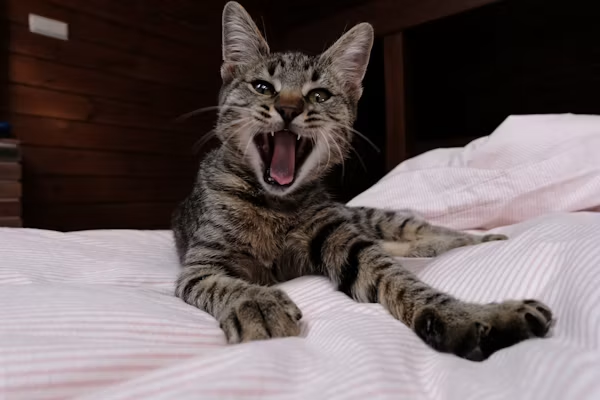
There is something about a cat meowing at 3 a.m. that makes the sound seem much louder than it would during the day.
The house is quiet, everyone is supposed to be sleeping, and suddenly your cat decides it is the perfect time to start a conversation.
If this happens to you, you may have wondered: Why does my cat meow at night?
The answer is not always the same. Your cat may be hungry, bored, looking for attention, responding to its natural activity cycle, or simply trying to tell you that it wants something.
Sometimes, nighttime meowing can also be connected to changes in a cat’s health or routine.
Understanding the reason behind the behavior can make it much easier to know what to do.
Cats Are Not Really Nocturnal
One of the first things to understand is that cats are not truly nocturnal.
Cats are generally crepuscular, which means they tend to be most active around dawn and dusk. This comes from their natural hunting patterns and helps explain why a cat that sleeps peacefully during part of the day can suddenly become energetic in the evening or early morning.
For your cat, 4 a.m. may not feel like the middle of the night in the same way it does to you.
It may simply be a time when your cat naturally feels more awake.
Your Cat May Have Too Much Energy
A cat that spends much of the day sleeping may have plenty of energy left when you are ready for bed.
This can be especially noticeable in young cats, but adult cats can also become active at night if they have not had enough play, movement, or mental stimulation during the day.
Your cat may suddenly run through the house, play with toys, explore different rooms, or start meowing because it wants something to happen.
In other words, your cat may be awake while you are trying very hard not to be.
Your Cat May Be Bored
Sometimes nighttime meowing is simply a request for something interesting to do.
During the day, your cat may have more opportunities to watch birds through a window, interact with you, explore the house, or play.
At night, when everything becomes quiet, boredom can become more noticeable.
A cat that feels under-stimulated may start vocalizing because it wants interaction.
This is one reason that play and enrichment during the day can make a difference to nighttime behavior.
Your Cat May Want Attention
Cats quickly learn that meowing gets a human’s attention.
If your cat meows and you immediately get out of bed, talk to it, pet it, or give it food, your cat may learn that nighttime meowing works.
From your perspective, you are simply trying to make the noise stop.
From your cat’s perspective, the experiment was successful.
Meow → human responds.
The behavior can become a habit when it is repeatedly rewarded with attention.
That does not mean your cat is being manipulative. It simply means cats can learn which behaviors produce a response from their humans.
Your Cat May Be Hungry
Food is another common reason cats become vocal at night.
If your cat is used to eating at a particular time and expects food during the night or early morning, it may remind you.
Some cats become especially persistent when they know breakfast is coming.
If you regularly get up and feed your cat after nighttime meowing, your cat may eventually connect the two events.
The message becomes very simple:
“If I meow, breakfast happens sooner.”
That can be difficult to unteach once the routine becomes established.
Your Cat May Want You to Open a Door
Cats are curious creatures, and they often want access to places that happen to be closed at night.
A bedroom door, bathroom door, closet, or another room can suddenly become extremely important when you are trying to sleep.
Your cat may meow because it wants to enter a room, leave a room, look outside, or simply investigate what is happening on the other side of the door.
Sometimes the mystery of a closed door is enough to keep a cat interested.
Your Cat May Feel Lonely
Not every nighttime meow is about food or play.
Some cats simply want to know where their people are.
If your cat is used to spending a lot of time with you during the day, the sudden quietness of nighttime may feel different.
A cat may meow because it wants reassurance or companionship, especially after a change in routine, environment, or household.
If your cat settles down once it knows you are nearby, loneliness or a desire for contact may be part of the explanation.
Your Cat May Be Responding to Its Environment
Cats are sensitive to changes around them.
A new piece of furniture, another pet, unfamiliar sounds outside, a change in your schedule, or even a new home can affect how comfortable a cat feels at night.
Because the house is quieter after dark, some sounds that go unnoticed during the day can become more obvious.
Your cat may hear something outside, notice another animal, or simply become more alert to its surroundings.
Nighttime can make a familiar house feel surprisingly different.
Why Does My Cat Meow at Night and Not During the Day?
This is one of the most confusing parts for cat owners.
During the day, your cat may barely make a sound.
Then nighttime arrives and suddenly you have a very talkative roommate.
The difference may be related to your cat’s natural activity cycle, the amount of stimulation available during the day, or the fact that nighttime gives your cat fewer distractions.
There is also another simple explanation: you are awake during the day and asleep at night.
Your cat may be communicating at other times too, but nighttime meowing is much harder for you to ignore because you are trying to sleep.
Why Does My Cat Meow at Me?
Cats often use meowing to communicate with people. Meowing is one of the main ways cats communicate with people, and different situations can give the sound different meanings.
They may be asking for food, attention, access to something, play, or simply responding to your presence.
If your cat walks up to you and meows, pay attention to what happens immediately afterward.
Does it lead you toward the food bowl?
Does it sit beside the door?
Does it look at a toy?
Does it settle down when you speak to it?
These little details can help you understand what your cat may be trying to communicate.
And if your cat has other affectionate habits, such as licking you, those behaviors can also be part of the way it interacts with you.
Should You Ignore Your Cat When It Meows at Night?
There is no single answer that works for every cat.
First, make sure your cat has access to basic necessities such as water, a clean litter box, and a comfortable environment.
If everything is fine and the meowing has become a habit for attention or food, responding every time can reinforce the behavior.
For example, if your cat meows and you immediately get up to play, your cat may learn that nighttime is a good opportunity to get you moving.
A consistent routine is usually more helpful than reacting differently every night.
How Can You Help Your Cat Be Calmer at Night?
There are several simple things that may help your cat settle more easily.
You can provide play and interaction during the day, especially in the hours before bedtime.
Interactive toys can give your cat an opportunity to use both its body and its mind.
Keeping feeding times consistent may also help.
A comfortable sleeping area can give your cat another place to relax instead of wandering around looking for something to do.
The goal is not necessarily to make your cat sleep exactly when you do.
It is to create a routine that gives your cat enough stimulation, comfort, and predictability that nighttime becomes less exciting.
What If the Nighttime Meowing Is New?
A sudden change is worth paying attention to.
If your cat has always been quiet at night and suddenly starts meowing much more than usual, there may be something different going on.
Health problems can sometimes cause increased vocalization, particularly in older cats. Pain, certain illnesses, sensory changes, and age-related cognitive changes can all affect nighttime behavior.
You do not need to assume that something is wrong every time your cat makes noise at night.
But if the change is sudden, persistent, or accompanied by other unusual signs, it is worth talking to a veterinarian.
The important thing is to look at the whole picture rather than focusing on the meowing alone.
Why Does My Cat Meow at Night? The Simple Answer
So, why does your cat meow at night?
It could be because your cat is naturally more active around dawn and dusk. It could be hungry, bored, lonely, curious, or looking for attention.
It could also be a habit your cat has learned because nighttime meowing gets a response from you.
And sometimes, particularly when the behavior changes suddenly, it can be a sign that something needs closer attention.
The good news is that once you start looking at the timing and circumstances, your cat’s nighttime conversations may become easier to understand.
You may never convince your cat that 3 a.m. is not an appropriate time for a chat.
But at least you might eventually figure out what the conversation is about.