
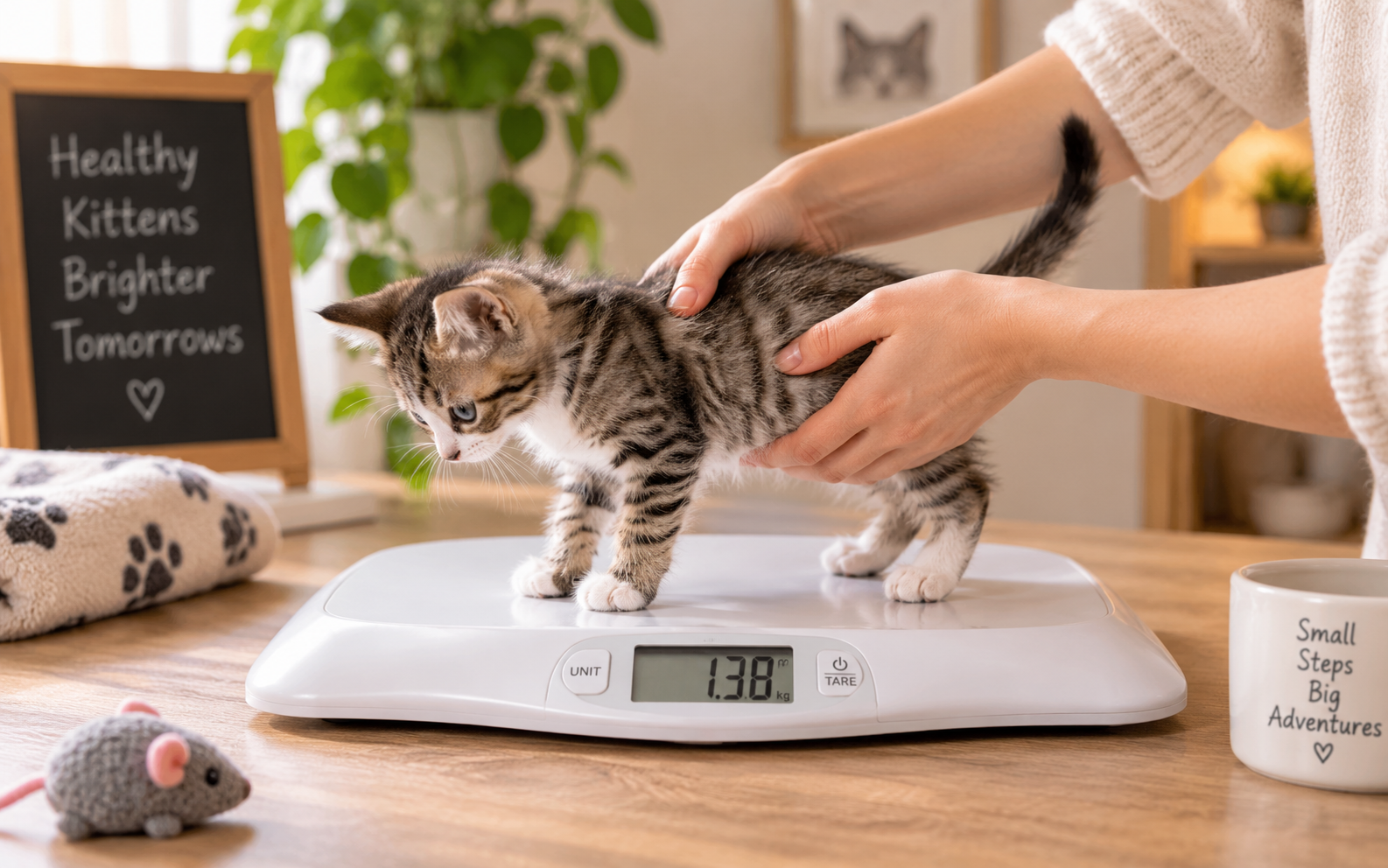
One of the first things people notice about a kitten is how incredibly small it is.
Then comes the question: How much should a kitten weigh at this age?
If you have just welcomed a kitten home, found one outdoors, or simply enjoy watching how quickly kittens grow, a kitten weight chart can be a useful reference.
Kittens grow remarkably fast during their first weeks and months. Their weight can give you a general idea of how they are developing, but it is important not to treat a single number as a rule.
A healthy kitten’s weight can vary depending on genetics, nutrition, litter size, and other factors.
So instead of asking whether your kitten matches one exact number, it is more useful to look at weight together with age and overall development.
Kitten Weight by Age at a Glance
The following table gives general weight ranges that can help you understand how quickly kittens grow.
| Approximate age | General weight range |
|---|---|
| Newborn | About 80–120 g |
| 1 week | About 150–200 g |
| 2 weeks | About 200–300 g |
| 3 weeks | About 250–350 g |
| 4 weeks | About 350–450 g |
| 5 weeks | About 400–550 g |
| 6 weeks | About 500–650 g |
| 7 weeks | About 550–750 g |
| 8 weeks | About 600–900 g |
| 3 months | About 1–1.5 kg |
| 4 months | About 1.5–2 kg |
| 5 months | About 2–2.5 kg |
| 6 months | About 2–3 kg |
These are broad estimates rather than exact targets. Individual kittens can fall outside these ranges and still develop normally. For another age-by-age reference, see the [Kitten Ageing Chart from Cats Protection].
These are broad estimates rather than exact targets. Individual kittens can fall outside these ranges and still develop normally.
For that reason, weight should always be interpreted alongside the kitten’s body condition, appetite, behavior, and developmental stage.
How Fast Do Kittens Gain Weight?
Kittens can gain weight surprisingly quickly.
During the first few weeks, even a small increase on the scale can represent an important part of a kitten’s growth.
A newborn kitten may weigh only around one hundred grams. A few weeks later, that same kitten can be several times heavier.
This rapid growth is one reason people are often surprised when they compare a newborn kitten with an eight-week-old kitten.
The difference can be enormous.
But growth does not happen at exactly the same speed for every kitten. Some kittens are naturally smaller, while others are larger.
The important thing is not simply how much the kitten weighs today, but how the kitten is developing over time.
Newborn Kitten Weight
Newborn kittens are tiny.
A healthy newborn commonly weighs somewhere around 80 to 120 grams, although there is natural variation.
At this stage, kittens are completely dependent on their mother for warmth and feeding.
They cannot regulate their environment like an older kitten, and they spend most of their time sleeping and nursing.
Because newborn kittens are so small, even modest changes in weight can be meaningful.
If you are caring for a newborn kitten, regular weighing can help you monitor growth, particularly if the kitten is orphaned or there are concerns about feeding.
1–2 Week Old Kitten Weight
During the second week, kittens are still very small, but their growth becomes easier to notice.
Their eyes begin opening, their ears start developing, and they become more mobile.
Weight commonly continues increasing steadily during this period.
A kitten that weighed around one hundred grams at birth may be closer to two hundred grams or more by the end of the second week.
But again, there is no single number that every kitten must reach.
The trend matters more than one isolated measurement.
3–4 Week Old Kitten Weight
Around three to four weeks, kittens begin changing rapidly.
They become more coordinated, start walking, explore their surroundings, and become increasingly curious.
Their baby teeth also begin appearing.
Weight continues to increase as the kitten grows and becomes more active.
By four weeks, many kittens weigh somewhere around 350 to 450 grams, although individual variation is normal.
At this age, looking at the kitten’s development can be just as informative as looking at the scale.
If you are trying to estimate a kitten’s age, you can compare its weight with other clues such as its teeth, eyes, ears, and ability to walk.
5–8 Week Old Kitten Weight
This is one of the most noticeable growth periods.
Between five and eight weeks, kittens become much more energetic.
They run, play, climb, pounce, groom themselves, and interact with their surroundings.
They are also becoming increasingly independent when it comes to eating.
Weight continues to rise during these weeks, but kittens can look very different from one another.
One eight-week-old kitten might look quite petite while another looks surprisingly chunky.
That does not automatically mean one is younger or healthier than the other.
Genetics, nutrition, and individual growth patterns all play a role.
Kitten Weight at 8 Weeks
Eight weeks is a common reference point because many kittens have become much more independent by this age.
A broad estimate might put an eight-week-old kitten somewhere around 600 to 900 grams.
But that range should not be treated as a pass-or-fail test.
A kitten slightly below or above that range is not automatically unhealthy.
Instead, consider the bigger picture:
- Is the kitten active?
- Is it eating normally?
- Is it gaining weight over time?
- Does it have good energy?
- Does its body condition look appropriate?
- Are its developmental milestones progressing?
Those questions provide much more useful information than a single number.
Kitten Weight From 3 to 6 Months
Once kittens reach three months, their growth continues, but the differences between individual cats become increasingly obvious.
A three-month-old kitten might weigh around 1 to 1.5 kilograms, while a six-month-old kitten might be closer to 2 to 3 kilograms.
Again, these are broad estimates.
Breed, sex, genetics, nutrition, and individual development can all influence adult size.
This is also when a kitten starts looking less like a tiny baby and more like a young cat.
Its legs lengthen, its body proportions change, and its movements become increasingly confident.
Does Kitten Weight Tell You How Old a Kitten Is?
It can give you a clue, but weight alone cannot tell you a kitten’s exact age.
This is particularly important if you found a kitten and are trying to estimate how old it is.
For example, two kittens that weigh the same might not be the same age.
One may simply be naturally smaller, while another may have had different nutrition or growth patterns.
If you are trying to estimate age, combine weight with other developmental clues. For a closer look at how these developmental signs can help you estimate a kitten’s age, read [How to Tell How Old a Kitten Is].
Look at:
- Eyes
- Ears
- Teeth
- Walking ability
- Coordination
- Eating habits
- Behavior
When several clues point toward the same age range, your estimate becomes much more reliable.
What Should a Kitten Weigh at 4 Weeks?
A four-week-old kitten often weighs somewhere around 350 to 450 grams.
At this age, you would also expect to see major developmental changes.
The kitten is becoming more coordinated, walking more confidently, exploring its surroundings, and beginning to show more interest in food.
If your kitten’s weight is somewhat different from the range above, that does not automatically mean something is wrong.
A veterinarian can assess the kitten’s body condition and development if you are concerned.
What Should a Kitten Weigh at 8 Weeks?
An eight-week-old kitten may weigh approximately 600 to 900 grams.
This is only a general guide.
A kitten’s weight depends on many factors, so the number on the scale should not be considered a precise requirement.
A kitten that is growing steadily and behaving normally may be perfectly healthy even if its weight does not match a chart exactly.
What Should a Kitten Weigh at 12 Weeks?
At around twelve weeks, many kittens weigh approximately 1 to 1.5 kilograms.
By this point, the kitten is usually energetic, coordinated, and much more independent.
It should look noticeably different from a newborn and should have gone through several major developmental stages.
If you are trying to estimate whether a kitten is around twelve weeks old, weight can support your estimate, but its physical development and behavior are also important.
Why Do Some Kittens Weigh More Than Others?
There is no universal kitten size.
Several factors can influence how much a kitten weighs.
Genetics
Some cats naturally grow larger than others.
A kitten’s eventual adult size is partly influenced by its genetic background, so comparing two unrelated kittens is not always useful.
Nutrition
Nutrition plays an important role in growth.
Kittens need appropriate nutrition during this rapid stage of development, and inadequate nutrition can affect growth.
Litter Size
Kittens from the same litter may still have different weights.
Competition for feeding and individual differences can influence growth patterns.
Health
Illness, parasites, or other health problems can affect a kitten’s ability to gain weight.
This is one reason a kitten that is consistently failing to gain weight deserves attention rather than simply being compared with an online chart.
How to Weigh a Kitten at Home
If you want to monitor a young kitten’s growth, a small digital kitchen scale can be useful.
Place a soft towel or shallow container on the scale and make sure the kitten is secure.
Then:
- Set the scale to zero with the towel or container in place.
- Gently place the kitten inside.
- Wait for the number to stabilize.
- Record the weight.
- Repeat measurements consistently.
For very young kittens, weighing at similar times and under similar conditions makes changes easier to compare.
Never leave a kitten unattended on a raised surface while weighing it.
What Matters More Than One Number?
Imagine that your kitten weighs 650 grams today.
Is that good?
By itself, you cannot really answer that question.
You would need to know the kitten’s approximate age, size, developmental stage, and whether its weight has been increasing normally.
That is why growth over time is often more informative than a single measurement.
A kitten that steadily gains weight may be developing well even if it does not fit neatly into an online chart.
On the other hand, a kitten that suddenly stops gaining weight or begins losing weight deserves closer attention.
When Should You Be Concerned About a Kitten’s Weight?
An online chart should never replace professional advice when a kitten appears unwell.
Consider contacting a veterinarian if a kitten:
- Is not gaining weight
- Is losing weight
- Refuses food
- Has very low energy
- Appears weak
- Has persistent vomiting or diarrhea
- Looks unusually thin
- Shows other signs of illness
Very young kittens can become vulnerable quickly, so it is better to ask for help when something does not seem right.
Kitten Weight by Age: The Big Picture
Watching a kitten grow is almost like watching a time-lapse video in real life.
A kitten that fits in the palm of your hand can become an energetic young cat in only a few months.
A kitten weight by age chart gives you a useful way to understand that transformation, but it should always be treated as a guide.
The most useful question isn’t:
“Does my kitten weigh exactly what the chart says?”
It is:
“Is my kitten growing steadily and developing normally?”
Use weight together with age, body condition, appetite, energy, and developmental milestones.
And if you’re trying to estimate your kitten’s age in the first place, remember that the scale is only one piece of the puzzle. Your kitten’s eyes, ears, teeth, movement, and behavior can tell you a lot too.
After all, kittens may not come with a birth certificate, but they certainly leave plenty of clues behind as they grow.