
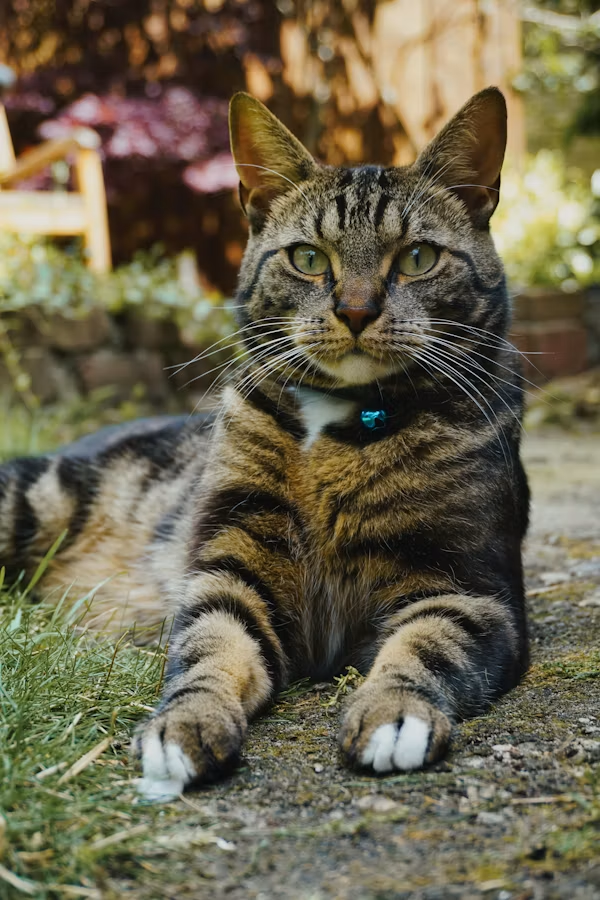
Have you ever looked at your cat and wondered what was going on in that little head?
Maybe your cat is sitting quietly with its ears pointed forward. Another moment, its tail starts moving, its pupils become wide, or its body suddenly gets tense. Is it curious? Happy? Nervous? Annoyed? Sometimes the answer is not obvious.
Cats communicate constantly through their bodies, but one signal rarely tells the whole story.
Your cat’s ears, eyes, tail, whiskers, facial expression, posture, and behavior all work together. Learning to read these signals can help you understand what your cat may be feeling and respond in a way that makes it feel safer and more comfortable.
The most important rule is simple: don’t read one body part in isolation. Look at the whole cat and the situation around it.
How to Read Your Cat’s Body Language
Cats communicate through subtle changes in their bodies. A tail movement, ear position, or change in posture can provide useful information, but the meaning depends on what the rest of the body is doing.
Look at the Whole Cat, Not Just One Signal
A cat’s tail can move for several reasons. Dilated pupils can happen because of fear, excitement, or changes in lighting. Ears turned backward may mean irritation or fear, but the rest of the cat’s posture helps tell you which is more likely.
Context matters, too.
A cat with wide pupils while watching a toy may be excited and ready to play. The same wide pupils combined with a crouched body, flattened ears, and a tucked tail may indicate fear.
Instead of asking, “What does this one signal mean?” ask:
What are all of my cat’s signals saying together?
That approach gives you a much more accurate picture.
What Your Cat’s Ears Are Telling You
Your cat’s ears can change position quickly in response to sounds, attention, excitement, fear, or irritation.
Ears forward usually suggest that your cat is interested or paying attention. If the rest of the body is relaxed, the cat may simply be curious about something nearby.
Ears turned sideways, sometimes called “airplane ears,” can appear when a cat is uncertain, overstimulated, anxious, or irritated.
Ears turned backward can indicate discomfort, tension, or that your cat is preparing to defend itself. Look at the rest of the body before deciding what the signal means.
Flattened ears are a stronger warning sign. When a cat presses its ears close to its head, especially together with a tense or crouched body, it may be frightened, defensive, or highly stressed.
The ears become much easier to interpret when you combine them with the eyes, tail, and posture.
What Your Cat’s Eyes Are Telling You
A cat’s eyes can reveal changes in attention and emotional state, but they need to be interpreted carefully.
Pupil Size
Cats’ pupils naturally change with the amount of light. They can also become larger during excitement, fear, or intense stimulation.
Because of that, large pupils do not automatically mean that your cat is scared.
Look at the environment and the rest of the body before drawing a conclusion.
Wide vs. Soft Eyes
Wide, alert eyes may indicate that your cat has noticed something interesting or unexpected.
Soft-looking eyes combined with a relaxed body can suggest that your cat is comfortable.
The difference is not just in the eyes themselves. It is in the overall expression.
Slow Blinking
A relaxed cat may slowly blink while looking at a person. This is often associated with calm, comfortable interaction.
If your cat gives you a slow blink, you can respond with a gentle slow blink of your own rather than staring intensely.
Staring
Direct staring can mean different things depending on the situation. A cat watching something intently may simply be focused on it.
The important point is not to interpret staring by itself. Consider the ears, pupils, facial tension, posture, and what is happening around your cat.
What Your Cat’s Tail Is Telling You
The tail is one of the easiest parts of a cat to notice, but it is also easy to misinterpret.
A tail held high often appears when a cat is comfortable and socially confident.
A relaxed tail generally fits with a relaxed cat, especially when the rest of the body is loose.
A low or tucked tail can indicate uncertainty, fear, or discomfort.
A puffed-up tail is a strong sign of heightened arousal. Your cat may be frightened, startled, or preparing to defend itself.
A flicking or rapidly moving tail does not automatically mean happiness. Depending on the situation, it can indicate excitement, irritation, or overstimulation.
A quivering tail can occur during moments of excitement or social interaction, but context is important here as well.
For a more detailed guide to individual tail positions, see our article o Cat Tail Language: Common Positions & What They Mean.
What Your Cat’s Whiskers and Face Are Telling You
Whiskers are not just decorative. They are highly sensitive structures that help cats gather information about their surroundings.
When a cat is relaxed, its whiskers may sit naturally to the sides.
Whiskers pushed forward can appear when a cat is interested in something, particularly when it is investigating or focusing on an object.
Whiskers pulled back can accompany fear, stress, or discomfort.
Facial tension can also provide useful information. A tense expression combined with flattened ears, a rigid body, or a tucked tail is very different from a relaxed face on a loose, comfortable body.
Pay attention to changes rather than trying to assign one permanent meaning to every whisker position.
What Your Cat’s Body Position Can Tell You
Your cat’s posture can sometimes tell you more than a single facial or tail signal.
A relaxed, loose body usually suggests that your cat feels comfortable in its surroundings.
A crouched or low body may indicate uncertainty, fear, or a desire to make itself less noticeable.
A tense or frozen body can signal that your cat is highly alert or uncomfortable.
An arched back, especially with raised fur and a sideways stance, can make a cat appear larger when it feels threatened.
A stretched-out body can be consistent with relaxation, particularly when the cat’s muscles appear loose.
A cat that is hiding or retreating may be telling you that it needs distance. This is especially important when other signs of fear or stress are present.
And then there is the famous belly-up position.
A cat exposing its belly does not automatically mean, “Please rub my belly.”
Sometimes a cat is relaxed. Sometimes it is stretching or playing. The belly is also a vulnerable area, so reaching for it can make some cats react defensively.
Again, context matters.
What Different Cat Body Language Can Mean
Once you start looking at several signals together, common emotional states become easier to recognize.
Relaxed and Comfortable
A relaxed cat may have a loose body, natural ears, soft eyes, and a tail resting comfortably.
It may stretch out, settle into a favorite place, groom itself, or simply observe what is happening without appearing tense.
Happy and Friendly
A comfortable, social cat may approach with its body relaxed and its tail held naturally or upright.
Soft facial expressions, relaxed ears, and willingness to remain near you can all fit with friendly interaction.
Individual cats show affection differently, so avoid expecting every cat to behave the same way.
Curious and Alert
A curious cat may hold its ears forward, focus its eyes on something interesting, and orient its body toward the source of attention.
It may pause, investigate, sniff, or move closer.
Alert does not necessarily mean anxious. A cat can be highly attentive while remaining completely comfortable.
Playful and Excited
During play, a cat may become more animated. Its pupils may enlarge, its body may shift quickly, and its tail may move more actively.
Play can sometimes look dramatic, especially when a cat is stalking, pouncing, or chasing a toy.
Look at the overall interaction rather than interpreting energetic movement as aggression automatically.
Anxious or Stressed
A stressed cat may crouch, hide, avoid interaction, hold its ears differently, or keep its body tense.
Some cats become very quiet when stressed rather than showing obvious signs.
Changes from your cat’s normal behavior can be particularly useful clues.
Afraid
Fear may appear as a combination of flattened or backward ears, a low or tucked body, wide eyes, a lowered tail, hiding, or an attempt to retreat.
A frightened cat may also become defensive if it feels trapped.
Giving the cat space is usually more helpful than forcing contact.
Overstimulated or Irritated
A cat that has had enough interaction may become tense, move its tail sharply, turn its ears, or shift away.
This can happen during petting or play.
Learning your cat’s early warning signs can help you stop an interaction before the cat feels the need to escalate.
Defensive or Aggressive
A defensive cat may try to look larger by arching its back, puffing its fur, turning sideways, or flattening its ears.
Hissing, growling, swatting, or other defensive behaviors may accompany these signals.
Defensive behavior does not necessarily mean that a cat is naturally aggressive. It can be a response to fear, pain, or feeling threatened.
Sick or in Pain
Pain or illness can sometimes change a cat’s normal body language.
A cat that suddenly hides more, becomes unusually withdrawn, sits in an unusual posture, stops grooming normally, or seems tense may need closer attention.
Behavioral changes are especially important when they occur together with changes in appetite, energy, grooming, litter box habits, or other physical signs.
How to Read Several Signals Together
This is the most useful skill when learning cat body language:
Don’t read one signal. Read the combination.
For example:
Forward ears + soft eyes + relaxed body
→ Your cat is likely comfortable and interested.
Flattened ears + crouched body + tucked tail
→ Your cat may be frightened or defensive.
Dilated pupils + tense body + rapidly moving tail
→ Your cat may be highly excited, stressed, or overstimulated. Look at what is happening around it.
Puffed fur + arched back + sideways posture
→ Your cat may be frightened and using defensive body language to appear larger.
The same body part can communicate different things in different situations. That’s why combinations are more useful than isolated signals.
Common Cat Body Language Mistakes
One of the easiest ways to misunderstand a cat is to assume that every signal has one fixed meaning.
Common mistakes include:
- Assuming a flicking tail means happiness.
- Assuming an exposed belly means your cat wants to be touched there.
- Assuming every dilated pupil means fear.
- Interpreting one body part without considering the rest of the cat.
- Confusing energetic play with aggression.
- Ignoring a sudden change from your cat’s usual behavior.
The more familiar you become with your individual cat, the easier it becomes to notice what is normal for them and what is unusual.
When a Change in Body Language May Mean Something Is Wrong
Not every unusual behavior is an emergency, but a sudden or persistent change deserves attention.
Pay particular attention if your cat begins hiding much more than usual, develops an unusual posture, seems consistently tense, becomes unusually withdrawn, or shows signs that it may be in pain.
Changes in body language are even more important when they occur alongside changes in grooming, appetite, energy, movement, or other normal habits.
Cats can hide signs of illness, so a noticeable change from your cat’s normal behavior should not simply be dismissed as a personality change. [Signs of illness] can sometimes be subtle in cats, which is why persistent or concerning changes deserve attention.
If you are concerned that your cat may be sick, injured, or in pain, contact a veterinarian for advice.
Frequently Asked Questions
What is my cat trying to tell me with its body language?
Your cat may communicate comfort, curiosity, fear, stress, excitement, irritation, or other emotional states through its ears, eyes, tail, whiskers, facial expression, and posture. The most accurate interpretation comes from looking at several signals together and considering the situation.
How can you tell if a cat is happy?
A comfortable cat often has a relaxed body, natural ears, soft eyes, and a relaxed tail. It may stretch out, explore normally, groom itself, or choose to stay near people without appearing tense.
What does it mean when a cat’s ears are back?
Ears turned backward can indicate uncertainty, irritation, fear, or tension. Look at the rest of the cat’s body and the surrounding situation before deciding what the signal means.
What does a cat’s tail position mean?
Tail position can provide clues about your cat’s emotional state. A high tail may fit with confidence or friendly interaction, while a tucked or puffed tail can indicate fear or heightened arousal. Tail movement should always be interpreted with the rest of the body.
How do you know if a cat is scared?
A frightened cat may crouch, hide, retreat, flatten its ears, tuck its tail, widen its eyes, or become defensive. Several of these signals appearing together are more meaningful than any one sign alone.
What does slow blinking mean?
Slow blinking is commonly associated with relaxed, comfortable interaction. If your cat slowly blinks at you, responding with a gentle slow blink can be a calm form of interaction.
How can you tell if a cat wants to be left alone?
A cat may want space if it retreats, hides, becomes tense, turns its ears back, moves its tail sharply, or shows other signs of discomfort. Giving the cat the option to move away is usually better than forcing interaction.