
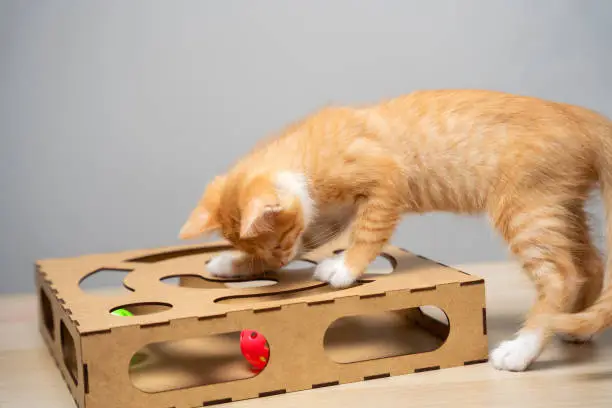
Have you ever noticed your cat suddenly racing through the house, attacking a toy for a few minutes, and then looking completely bored again?
Indoor cats can have everything they need to be safe and comfortable and still lack something important: opportunities to use their natural instincts.
Cats are natural hunters, climbers, explorers, scratchers, and problem-solvers. Enrichment gives them safe ways to express these behaviors in everyday life. And it does not have to mean buying a house full of expensive toys.
From simple cardboard boxes and window perches to food puzzles, interactive play, and DIY activities, there are many ways to make a cat’s environment more interesting.
The best cat enrichment ideas are not necessarily the most complicated ones. They are the ones that give your cat opportunities to move, explore, think, hunt, scratch, climb, and make choices.
What Is Cat Enrichment?
Cat enrichment means providing experiences, activities, and changes in the environment that encourage natural feline behaviors and keep a cat mentally and physically stimulated.
For an indoor cat, enrichment can be especially important because the home environment may offer fewer opportunities for exploration and hunting than the outdoor world.
Enrichment can include:
- Interactive play
- Food puzzles and foraging
- Scratching surfaces
- Vertical spaces
- Hiding places
- Window perches
- Tunnels and boxes
- New smells and objects
- Safe exploration
- Training and problem-solving activities
The goal is not to keep your cat busy every minute of the day. Instead, enrichment gives your cat meaningful things to do when they want to explore or interact with their environment.
Why Do Cats Need Enrichment?
Cats have natural behaviors that do not disappear simply because they live indoors.
A cat may still want to stalk something that moves, chase a small object, climb to a high place, investigate a new smell, scratch a surface, or search for food.
Without enough stimulation, some cats may become bored or frustrated. You might notice behaviors such as excessive attention-seeking, destructive scratching, overeating, inactivity, or repeated attempts to create their own entertainment.
Enrichment can also encourage movement and provide opportunities for cats to make choices about how they spend their time.
This is particularly useful for indoor cats, but all cats can benefit from enrichment.
1. Use Interactive Toys for Hunting Games
One of the simplest ways to enrich a cat’s day is to play with them using an interactive toy.
Wand toys and feather teasers can imitate the movement of prey. Instead of simply waving the toy directly in front of your cat, move it unpredictably across the floor, around furniture, or behind an object.
Let your cat stalk, chase, pounce, and eventually catch the toy.
This type of play gives your cat an opportunity to practice parts of the natural hunting sequence.
Try changing the movement rather than repeating the same motion every time. Some cats prefer something that moves along the floor, while others enjoy toys that move through the air.
Always supervise interactive toys and put away toys with strings or other parts that could be swallowed when playtime is over.
2. Try Food Puzzles and Foraging
Cats do not have to receive every meal from an ordinary bowl.
Food puzzles and puzzle feeders can turn part of mealtime into a problem-solving activity.
You can place a portion of your cat’s regular food inside a puzzle feeder and allow them to work out how to access it.
For a simpler option, hide small portions of dry food around safe areas of the home so your cat can search for them.
Start with easy challenges. If a puzzle is too difficult, a cat may simply lose interest.
Foraging activities are especially useful because they combine food with movement, investigation, and problem-solving.
3. Create Vertical Space
Look around your home from your cat’s perspective.
A room that seems full of possibilities to a human may offer very little usable space for a cat.
Cats often enjoy being able to climb and observe their surroundings from above.
A cat tree, secure shelf, climbing structure, or elevated resting area can create vertical territory.
You do not necessarily need an elaborate setup. Even a simple, stable perch near a favorite area can add another dimension to the environment.
Make sure anything your cat can climb is secure and cannot easily fall.
4. Give Your Cat a Window View
A window can become one of the easiest forms of cat enrichment.
A secure window perch gives a cat an opportunity to watch birds, insects, people, cars, and changing weather outside.
For some cats, simply observing the world provides plenty of stimulation.
If your cat enjoys looking outside, consider placing a comfortable resting spot near a safe window.
You can also change what is available to observe by occasionally moving the perch to another appropriate location.
5. Offer Boxes, Tunnels, and Hiding Places
Never underestimate the entertainment value of a cardboard box.
Boxes can provide places to hide, investigate, jump into, or ambush a toy.
You can also combine several boxes to create a simple exploration area.
Tunnels offer another way for cats to move through an environment while remaining partially hidden.
Some cats prefer enclosed spaces, while others prefer open areas where they can observe everything around them.
Providing choices allows your cat to decide what feels comfortable.
6. Make DIY Cat Enrichment Activities
You do not have to spend a lot of money on cat enrichment.
Simple household items can become interesting activities when used safely.
For example, you can create a basic food puzzle from a cardboard box by making appropriately sized openings and placing pieces of your cat’s regular food inside.
Another simple idea is to place small treats or pieces of dry food in safe cardboard containers that encourage your cat to investigate.
You can also create a basic maze using cardboard boxes.
The important part is to supervise homemade activities and remove anything that becomes damaged or produces pieces that could be swallowed.
7. Rotate Your Cat’s Toys
Does your cat ignore toys that once seemed exciting?
Try rotating them instead of leaving everything available all the time.
Put some toys away for a while and bring them back later. A familiar toy can become interesting again when it has not been available for several days.
You can also vary the type of stimulation.
For example, one day might include a wand toy, while another includes a puzzle feeder or cardboard box.
Toy rotation can make enrichment feel new without requiring you to constantly buy something different.
8. Provide Different Scratching Opportunities
Scratching is a normal feline behavior, so enrichment should include appropriate places to scratch.
Instead of offering only one scratching post, consider providing different surfaces and positions.
Some cats prefer vertical scratching posts. Others may prefer horizontal cardboard scratchers.
Place scratching surfaces in areas where your cat already spends time, particularly near resting areas or places where they naturally scratch.
Providing appropriate alternatives can also help protect furniture from unwanted scratching.
9. Encourage Safe Exploration
Cats often enjoy investigating something new.
You can introduce small changes to their environment, such as a new cardboard box, a different safe object, or a new resting location.
You can also allow your cat to investigate safe smells and textures.
The key is not to overwhelm them.
Some cats become excited by novelty, while others are cautious. Let your cat approach new things at their own pace rather than forcing interaction.
10. Teach Simple Tricks
Training is another form of cat enrichment.
Cats can learn simple behaviors using rewards and positive reinforcement.
Depending on your cat’s personality, you might teach them to:
- Come when called
- Touch your hand with their nose
- Sit
- Follow a target
- Enter a carrier voluntarily
- Use a scratching post
Training sessions do not need to be long.
A few minutes of focused interaction can give your cat a mental challenge while also strengthening the relationship between you.
11. Help a Bored Cat Exercise
Some cats naturally spend more time moving than others.
For a cat that is mostly sedentary, enrichment can encourage additional activity through play and exploration.
Try creating a simple route through the room using a cat tree, scratching post, tunnel, and toys.
You can also move a wand toy so that your cat has to walk, run, jump, or change direction.
The activity should match your cat’s age, physical ability, and personality.
12. Give Your Cat Choices
One of the most overlooked parts of enrichment is choice.
Instead of deciding exactly what your cat should do, provide several safe options.
For example, your cat might have access to:
- A quiet hiding place
- A high resting spot
- A scratching surface
- A window
- A toy
- A food puzzle
- A comfortable bed
Your cat can then choose where to rest, explore, play, or observe.
This can make enrichment more meaningful because different cats have different preferences. Understanding the signs that your cat trusts you can also help you recognize which activities and spaces make your cat feel comfortable and secure.
What Are the Best Enrichment Ideas for Indoor Cats?
There is no single best enrichment activity for every cat.
An energetic young cat may love interactive chasing games. A food-motivated cat may prefer puzzle feeders. A cautious cat may get more enjoyment from boxes and hiding places. Another cat may spend hours watching the world from a window.
A good indoor enrichment routine combines several types of stimulation.
For example:
Morning: a short interactive play session.
During the day: access to a window perch, scratching area, and safe resting spaces.
Mealtime: part of the daily food served through a puzzle feeder.
Evening: another play session followed by a chance to “catch” the toy.
This gives the cat different experiences instead of relying on one activity.
How Do You Know if Your Cat Needs More Enrichment?
Boredom can look different from one cat to another.
Possible signs include:
- Sleeping excessively when normally active
- Demanding attention constantly
- Repeatedly getting into trouble
- Scratching inappropriate objects
- Overeating
- Chasing or attacking things around the house
- Showing little interest in their environment
- Becoming frustrated during periods of inactivity
These behaviors do not automatically mean that your cat is bored. Changes in behavior can have other causes, including health or stress.
If a behavior changes suddenly or seems unusual, it is worth discussing it with a veterinarian.
How Much Enrichment Does a Cat Need?
There is no universal number of minutes or activities that every cat needs.
Age, personality, health, living environment, and activity level all make a difference.
Rather than trying to meet a fixed number, pay attention to how your cat responds.
A good enrichment activity usually leaves the cat interested and engaged without causing excessive frustration or overstimulation.
Short, regular activities can be more useful than occasionally giving your cat a huge amount of stimulation.
Final Thoughts
Cat enrichment does not have to be expensive, complicated, or time-consuming.
A cardboard box, a window, a scratching surface, a food puzzle, or a few minutes of interactive play can give a cat opportunities to use important natural behaviors.
The best approach is to offer variety.
Let your cat hunt, climb, scratch, explore, forage, play, and rest. Rotate activities and toys, introduce new experiences gradually, and pay attention to what your individual cat enjoys most.
After all, enrichment is not about finding the most impressive collection of cat toys.
It is about creating an environment where your cat has interesting things to do and meaningful choices to make every day.