
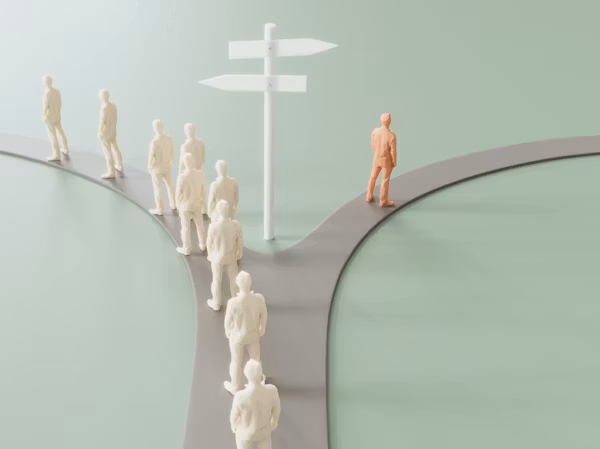
There is a quiet kind of anxiety that doesn’t arrive all at once.
It builds slowly.
Not because something terrible happened.
Not because your life is falling apart.
But because, little by little, you start looking around and wondering whether everyone else is moving faster than you.
A friend gets married.
Someone you studied with buys a house.
A former coworker announces a promotion.
Another person starts a business.
Someone else seems to be traveling the world while you are still trying to figure out next month.
None of these events are necessarily painful on their own.
What hurts is the story your mind quietly creates from them.
A story that says:
“Everyone is moving forward except me.”
Over time, that story can become so familiar that you stop questioning it.
You stop noticing your own progress.
You stop recognizing how much you have survived.
You stop appreciating how many invisible battles you have already won.
Instead, your attention becomes fixed on everything that still hasn’t happened.
The life you thought you would have by now.
The version of yourself you expected to become.
The milestones that somehow seem late.
The strange thing is that feeling behind is often less about reality and more about perception.
Many people who believe they are falling behind are actually growing in ways that cannot be measured from the outside.
They are healing.
Learning.
Rebuilding.
Recovering.
Changing.
And those kinds of progress rarely look impressive on social media.
The Quiet Pressure of Feeling Behind
Most people do not wake up one morning and suddenly decide they are behind in life.
The feeling develops through comparison.
Not dramatic comparison.
Small comparison.
Daily comparison.
You scroll through your phone.
You hear a conversation.
You attend a family gathering.
You see an old acquaintance.
And without realizing it, your brain begins collecting evidence.
Evidence that everyone else appears to know exactly what they are doing.
The problem is that you are comparing your private reality with someone else’s public highlights.
You know your doubts.
You know your fears.
You know the mistakes you made.
You know how often you feel uncertain.
But you do not have access to those same details in other people’s lives.
As a result, their lives appear more complete than they really are.
Their progress appears smoother.
Their confidence appears stronger.
Their path appears clearer.
And eventually, you begin measuring yourself against an illusion.
Not a person.
An illusion.
That is why feeling behind can remain present even when you are objectively doing well.
The feeling is not always connected to facts.
It is connected to interpretation.
Why Modern Life Makes Comparison Almost Impossible to Avoid
Human beings have always compared themselves to others.
But modern life has amplified this tendency in ways previous generations never experienced.
Today, you can see hundreds of people’s achievements before breakfast.
Promotions.
Engagements.
Fitness transformations.
Business launches.
New homes.
Dream vacations.
Personal milestones.
The mind was never designed to process this amount of information every day.
What makes it even more difficult is that people naturally share moments of success more often than moments of struggle.
Very few people post pictures of uncertainty.
Very few people announce periods of confusion.
Very few people publicly discuss the nights they spend wondering whether they are making the right decisions.
As a result, your brain receives an incomplete version of reality.
And when you repeatedly consume incomplete information, you often create inaccurate conclusions.
One of the most common conclusions is:
“I’m behind.”
The Problem With Invisible Timelines
One of the biggest reasons people feel behind is because they are trying to follow timelines they never consciously chose.
At some point, many of us absorb ideas about how life is supposed to unfold.
Graduate by a certain age.
Build a career by a certain age.
Get married by a certain age.
Buy a home by a certain age.
Achieve financial stability by a certain age.
The problem is not having goals.
The problem is believing that every meaningful life must follow the same schedule.
Career Timelines
Some people discover their calling early.
Others spend years exploring different paths.
Neither approach is wrong.
A person who finds purpose at twenty-five is not automatically ahead of someone who finds it at forty-five.
Life is not a race toward a finish line.
It is a process of becoming.
Relationship Timelines
Many people quietly carry shame because their relationships do not match the expectations around them.
But relationships are not achievements.
They are experiences.
Being single is not evidence of failure.
Being married is not proof of success.
Every path contains its own lessons, joys, and challenges.
Personal Achievement Timelines
Sometimes people spend years chasing goals they never consciously chose for themselves.
When that happens, even success can feel strangely empty.
Because achieving the wrong goal never creates lasting fulfillment.
The Moment Everything Begins to Change
The biggest shift happens when you stop asking:
“Why am I behind?”
And start asking:
“Behind whom?”
That question changes everything.
Because it forces you to examine the standard you are using.
Who created it?
Who decided your life should look a certain way by now?
Was it truly your dream?
Or was it something absorbed from family, culture, friends, or society?
Many people spend years feeling inadequate because they are trying to follow a map that was never designed for them.
And no matter how hard they work, they continue feeling lost.
Not because they are failing.
Because they are traveling toward someone else’s destination.
The goal was never theirs.
The timeline was never theirs.
The expectations were never theirs.
Yet they carry the weight of those expectations every day.
The moment you recognize this, something important happens.
You stop measuring your life according to borrowed standards.
And for the first time, you begin asking what actually matters to you.
How Feeling Behind Changes the Way You See Yourself
When the feeling lasts long enough, it begins affecting more than your mood.
It changes your identity.
You stop seeing yourself as a person who is growing.
You begin seeing yourself as a person who is failing.
That shift is dangerous.
Because eventually you stop celebrating progress.
You stop acknowledging effort.
You stop recognizing resilience.
Everything becomes focused on what is missing.
You could be making meaningful progress every year and still feel stuck because your attention is permanently directed toward the gap between where you are and where you think you should be.
This creates a painful cycle.
The more behind you feel, the less confident you become.
The less confident you become, the harder it becomes to take action.
The harder it becomes to take action, the more behind you feel.
Breaking this cycle requires a different perspective.
Not more pressure.
Not more comparison.
A different perspective.
What Happens When You Stop Measuring Your Life Against Everyone Else’s
The goal is not to eliminate comparison completely.
That would be unrealistic.
The goal is to stop allowing comparison to define your worth.
Define What Progress Means to You
Many people know what society calls success.
Far fewer know what success personally means to them.
Take time to ask yourself:
What kind of life am I actually trying to build?
What matters most to me?
What values do I want my decisions to reflect?
The answers may surprise you.
Look at the Last Five Years, Not the Last Five Days
When people feel behind, they often focus on short periods of time.
A difficult week.
A stressful month.
A disappointing season.
But real growth usually becomes visible over longer periods.
Look at who you were five years ago.
Look at what you have learned.
Look at what you have survived.
Look at the ways you have changed.
The progress may be larger than you realize.
Measure Direction, Not Speed
Speed is overrated.
Direction matters more.
Some people move quickly toward lives they later regret.
Others move slowly toward lives that genuinely fulfill them.
What matters is not how fast you are moving.
What matters is whether you are moving toward something meaningful.
Stop Using Milestones as Proof of Worth
A promotion is not proof of value.
A relationship is not proof of value.
A house is not proof of value.
These are life events.
Not measurements of human worth.
The moment you separate achievement from identity, comparison loses much of its power.
A Different Way to Think About Progress
Sometimes the feeling of being behind comes from believing that life should already look different than it does today.
But life is rarely transformed by one dramatic moment.
Most meaningful change happens gradually.
Quietly.
Almost invisibly.
One decision.
One lesson.
One recovery.
One step at a time.
Progress is not always exciting.
Sometimes progress looks like healing after a difficult season.
Sometimes it looks like learning to trust yourself again.
Sometimes it looks like simply continuing when giving up would have been easier.
Those moments count.
They always count.
Conclusion
The truth is that life is not a race where everyone starts at the same place and follows the same path.
Some people are building.
Some are rebuilding.
Some are recovering.
Some are discovering who they are.
Some are learning lessons that will shape the rest of their lives.
All of these things are forms of progress.
If you often feel like you are falling behind, take a moment to question the standard you are using.
Ask yourself whether it truly belongs to you.
Because perhaps you are not behind at all.
Perhaps you are simply living a different story.
And perhaps that story is unfolding exactly the way it needs to.

Hi, I’m Regina.
I’m a curious person who likes to notice things.
Sometimes it’s a thought that stays in my head all day. Sometimes it’s something I discover, a question I suddenly want to answer, a dream I cannot stop thinking about, or something completely ordinary that somehow becomes interesting.
I created Vida e Palavras as a place to explore all of that through words.
Here, I write about everyday life, emotions, habits, dreams, curiosity, inspiration, and the small things that make us stop and think.
I’m not here to pretend I have all the answers. I’m here to explore, discover, and share ideas along the way.
I hope you find something here that makes you think, feel, learn, or simply pause for a moment.