
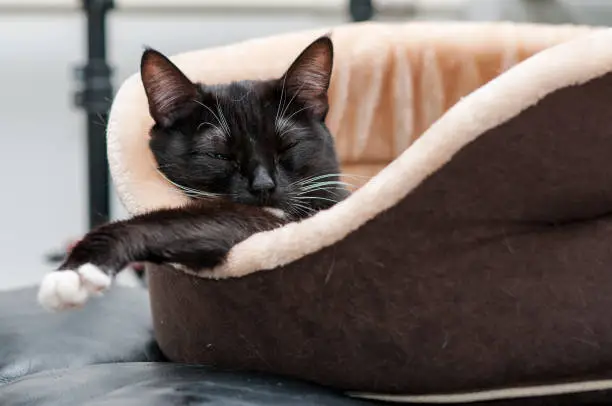
If you have ever watched a kitten fall asleep, you may have noticed something strange: they can be completely exhausted one minute and wide awake again not long after.
So how long do kittens actually sleep at a time?
Kittens tend to sleep in short periods throughout the day and night, rather than following one long, uninterrupted stretch of sleep. How long each nap lasts can vary depending on the kitten’s age, activity level, and individual routine.
How Long Does a Kitten Sleep at a Time?
There is no fixed length for a kitten’s nap.
A kitten may sleep for 30 minutes, an hour, a couple of hours, or sometimes longer before waking up again. Very young kittens can spend most of their day sleeping, waking mainly to eat and then settling down again.
If you’re wondering about the total amount of sleep kittens need each day, see How Much Do Kittens Sleep?
As kittens grow, their periods of activity generally become longer. They may still take plenty of naps, but their daily routine gradually becomes more varied.
So if your kitten sleeps for a while, wakes up to eat or play, and then goes back to sleep, that can be completely normal.
Why Don’t Kittens Sleep for One Long Stretch?
Kittens are not expected to sleep the way people do.
Their sleep is spread across many periods because they are constantly moving between eating, playing, exploring, and resting.
A young kitten has a small body and a lot of development happening at once. After being awake and active, they may need to rest again quite quickly.
You might see a pattern like:
Sleep → wake up → eat → play → explore → sleep again.
Sometimes the entire active period can seem surprisingly short.
That is one of the reasons life with a kitten can feel like a cycle of sudden energy followed by an equally sudden nap.
Do Newborn Kittens Sleep Longer?
Yes. Newborn kittens generally sleep for much of the day.
During the earliest stage of life, they have very limited independence. They spend most of their time sleeping and feeding, with their mother providing most of their care.
As they become older, they gradually spend more time awake and interacting with their surroundings.
This means that a newborn kitten may appear to be asleep almost constantly, while an older kitten may have much longer periods of play and exploration.
How Does Kitten Sleep Change With Age?
Sleep patterns change as kittens develop.
Newborn kittens: Sleep makes up most of their day, with waking periods mainly centered around feeding.
Young kittens: They begin spending more time awake, playing, walking around, and discovering their environment, but still need frequent naps.
Older kittens: Their active periods become longer and more energetic, although they continue to sleep considerably more than many people expect.
There is no exact age when every kitten suddenly changes its sleep schedule. Development happens gradually, and individual kittens can have different routines.
Why Does My Kitten Wake Up So Often?
Frequent waking is not necessarily a problem.
Kittens have small bodies and high energy needs, so they may wake up to eat, use the litter box, play, or simply explore for a while.
They can also become interested in something around them and suddenly decide that sleeping is over.
Then, after a short period of activity, they may become tired again and settle down for another nap.
This can make kitten sleep seem unpredictable, but it is often simply part of their stage of development.
Can a Kitten Sleep for Several Hours?
Yes.
A kitten can sleep for several hours, especially after a period of activity or when they are very young.
The important thing is to look at the overall pattern rather than focusing on one particular nap.
A kitten that sleeps for a few hours, wakes up normally, eats, plays, and behaves normally is very different from a kitten that suddenly becomes difficult to wake or loses interest in food and activity.
Should I Wake a Sleeping Kitten?
Most of the time, there is no reason to wake a healthy, sleeping kitten simply because they have been asleep for a while.
Sleep is an important part of kitten development, and allowing them to rest is generally appropriate.
However, very young kittens have different feeding and care needs from older kittens. If you are caring for a newborn or very young kitten, especially one separated from its mother, it is important to follow appropriate veterinary guidance about feeding and care.
When Is Long Sleep a Reason for Concern?
Sleeping for long periods can be normal for kittens.
What deserves more attention is a sudden change from the kitten’s usual behavior.
If your kitten is unusually difficult to wake, refuses food, seems weak, has trouble breathing, vomits repeatedly, develops diarrhea, or simply does not seem like themselves when awake, contact a veterinarian.
The number of hours alone does not tell you everything. How your kitten behaves when awake matters too.
The Simple Answer
So, how long do kittens sleep?
Kittens can sleep for short naps or several hours at a time, and they usually repeat these periods throughout the day and night.
Very young kittens tend to sleep for longer portions of the day, while older kittens gradually develop longer periods of activity.
There is no perfect nap length that every kitten should follow.
If your kitten sleeps, wakes normally, eats, plays, explores, and then happily goes back to sleep, that rhythm is often simply part of growing up.
For a kitten, a day can be a surprisingly simple routine:
sleep, wake, eat, play, explore — and sleep again.