
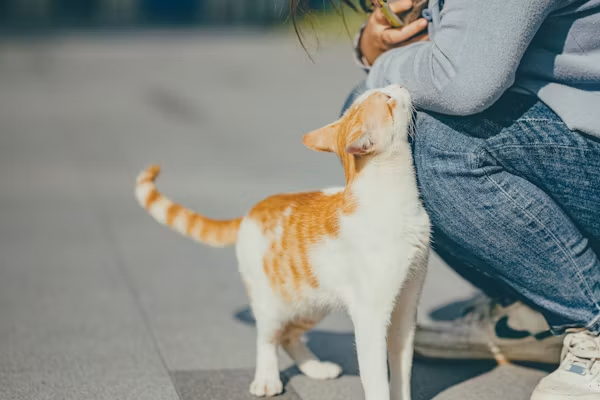
You are standing in the kitchen, walking down the hallway, or sitting on the couch when your cat suddenly walks over and rubs against your legs.
Maybe they rub their whole body against you. Maybe they press their face against your hand. Sometimes they do it while purring, and sometimes they rub against you and then simply walk away as if nothing happened.
It is easy to think, “My cat is being affectionate.”
And that may be part of it. But cats have several reasons for rubbing against people, and the meaning can change depending on what is happening around them.
So, why is your cat rubbing against you?
What Does It Mean When a Cat Rubs Against You?
When a cat rubs against you, they may be greeting you, communicating with you, leaving their scent, or showing that they feel comfortable around you.
They may also be trying to get something from you.
Cats have scent glands in several areas of their bodies, including around the cheeks, chin, head, and the base of the tail. When they rub these areas against you, they leave scent signals behind. Other cats can detect these signals even though we cannot smell them.
But scent is only part of the story.
The situation matters too.
A cat who runs to the door and rubs against your legs when you arrive home may be greeting you. A cat who rubs against your legs and then walks toward the food bowl may be asking for dinner. A cat who approaches a new person and briefly rubs against them may be gathering information rather than asking to be petted.
The same behavior can have slightly different meanings.
1. Your Cat May Be Saying Hello
One of the simplest explanations is also one of the sweetest.
Your cat may be greeting you.
Cats that are comfortable with people often use rubbing as part of a friendly greeting. You may notice it especially when you return home after being away or when your cat wakes up and comes looking for you.
The greeting may include more than rubbing. Your cat might approach with their tail held upright, look relaxed, purr, or stay close to you for a moment.
In that situation, the rubbing is part of a larger social interaction.
It is your cat’s way of saying, in their own language, that they have noticed you.
2. Your Cat Is Leaving Their Scent
This is one of the most interesting parts of the behavior.
Cats experience the world through scent in ways that are difficult for us to imagine. Their scent glands help them leave chemical signals on people, animals, and objects.
When your cat rubs their cheek or head against you, they are not simply giving you a little furry hug. They are also transferring some of their scent.
This is sometimes described as marking territory, but that description can make the behavior sound more possessive than it really is.
Scent can help a cat recognize what is familiar and what belongs to their social environment.
Cats that live together may also exchange scents, creating a more familiar group smell. So when your cat rubs against you, it can be part of maintaining that familiar connection.
And because scents do not last forever, cats may repeat the behavior.
That may help explain why your cat seems perfectly happy to rub against you again and again, even though you have not changed.
3. Your Cat May Feel Safe With You
Rubbing can also be part of a comfortable social relationship.
A cat does not have to behave affectionately in exactly the same way a dog does. Some cats show their comfort by sitting beside you. Others follow you from room to room. Some sleep near you.
And some cats repeatedly walk over and press their face or body against you.
The rubbing itself does not prove exactly what your cat is feeling. But when it happens together with relaxed body language, purring, a calm tail, or a willingness to stay close, it can be a good sign that your cat feels comfortable around you.
That is why the context matters so much.
Instead of asking only, “What does rubbing mean?”, it can be more useful to ask:
“What else is my cat doing at the same time?”
Your cat’s body language gives you more information.
4. Your Cat May Want Something
Sometimes your cat is not simply saying hello.
They may be asking for something.
Cats quickly learn that certain behaviors get a response from people. If rubbing against your legs leads to food, play, petting, or a door being opened, your cat may learn to repeat it when they want that particular thing.
You may even notice a little routine.
Your cat rubs against you.
You look at them.
They walk toward the kitchen.
You follow.
Suddenly, you discover that the “affectionate greeting” was also a very effective request for dinner.
This does not make the behavior fake. Cats can greet you and ask for something at the same time.
It simply means that communication between cats and people is more complicated than one behavior having one fixed meaning.
5. Your Cat May Be Checking Out a New Smell
This is easy to overlook.
Imagine that you have just come home after being somewhere else. You may smell different to your cat because you have picked up scents from other people, animals, food, outdoors, or another environment.
Your cat may approach you, sniff you, and rub against you.
That does not necessarily mean, “Please pet me.”
Your cat may be investigating what has changed.
Cats can use scent as information, so rubbing and sniffing can sometimes be part of figuring out who or what has entered their familiar environment.
This is especially important when a cat rubs against someone they do not know well.
The behavior can be friendly without being an invitation to immediately reach down and touch them.
Why Does My Cat Rub Their Face on Me?
If your cat presses or rubs their face against you, you are seeing a particularly interesting form of feline communication.
This behavior is often called bunting.
Cats have scent glands around parts of their face, including their cheeks, chin, and areas around the mouth and ears. When they rub these areas against you, they can leave behind their scent.
That is one reason a cat may rub their face against you, furniture, door frames, or other objects around the house.
It may look like a simple display of affection, but there is communication happening too.
And when your cat gently pushes their forehead or cheek against you, there is no need to assume that the only message is “I love you.”
It may be a combination of familiarity, social connection, greeting, and scent communication.
That makes the behavior even more interesting.
Why Does My Cat Rub Against My Legs?
Legs are simply an easy target.
They are at your cat’s height, they move around the house with you, and they are usually available when your cat approaches.
A cat may weave between your legs or rub along them when you arrive home, when they want attention, or when they are moving around you during a familiar routine.
If your cat rubs your legs and then heads toward their food, toy, or favorite door, pay attention to what happens next.
The next behavior may help explain the first one.
And yes, there is one practical problem with this particular form of affection:
your cat may not realize that you are trying to walk somewhere.
What If My Cat Rubs Against Me and Then Bites?
This can be confusing.
Your cat may rub against you, seem affectionate, and then give you a gentle bite.
That does not automatically mean the mood has changed from “I like you” to “I hate you.”
Cats can become excited during social interaction, and some cats use gentle biting as another form of communication. They may also become overstimulated during petting or shift quickly from social behavior into play.
The important thing is to look at the rest of the body language.
A relaxed cat that gives a brief, gentle nip is very different from a cat whose body becomes tense, whose ears flatten, whose tail starts lashing, or who clearly wants the interaction to stop.
If your cat is telling you they have had enough, give them some space.
Should You Pet Your Cat When They Rub Against You?
Usually, you can let your cat guide the interaction.
If your cat approaches you, stays close, leans into your hand, and appears relaxed, they may be happy to receive some attention.
But rubbing does not always mean, “Please pet me.”
A cat may rub against a new person while still deciding whether that person is safe. Another cat may rub against you simply as part of a greeting before walking away.
So instead of automatically reaching down every time, watch what your cat does next.
If they stay, lean toward your hand, or invite more contact, you have a better clue that they want interaction.
Learning to notice those small signals can make living with a cat much easier.
When Should You Be Concerned?
Rubbing against people, objects, and other cats is normally a common feline behavior.
The situation is different if your cat suddenly starts rubbing much more than usual, rubs aggressively or compulsively, or shows other unusual signs at the same time.
Changes in rubbing behavior can sometimes occur alongside problems such as allergies, fleas, ear infections, skin irritation, or neurological conditions.
Pay attention to other changes too, such as intense scratching, hair loss, unusual vocalization, a head tilt, confusion, or other changes in normal behavior.
You do not need to worry every time your cat rubs against you.
The important thing is noticing when the behavior is different from your cat’s normal pattern.
If a sudden or excessive change concerns you, a veterinarian can help determine whether there is an underlying problem.
So, Why Is My Cat Rubbing Against Me?
Most of the time, your cat rubbing against you is a positive interaction.
They may be saying hello. They may be leaving their scent. They may be showing that you are familiar and safe. They may want attention, food, play, or something else. Sometimes they may simply be checking out a new smell.
And sometimes, several of these things can happen at once.
That is the part that makes cats so interesting.
A cat rubbing against your legs is not necessarily delivering one simple message. They are using a behavior that can carry several kinds of information, and you can understand it better by looking at the whole moment.
So the next time your cat walks over, presses their little face against your leg, and then looks up at you, pay attention to what happens next.
That may be the part that tells you what they were really trying to say.