
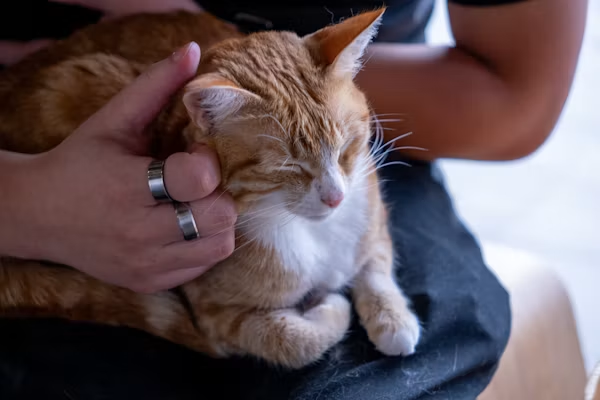
You are sitting comfortably on the couch when your cat climbs onto your lap. They turn around a few times, settle in, and then start pressing their front paws into your legs.
One paw goes down.
Then the other.
Again and again.
Sometimes the claws come out, too.
If your cat does this, you may have wondered, “Why does my cat knead me?”
This behavior is often called kneading or “making biscuits,” and it is one of the most recognizable things cats do. While no single explanation applies to every cat, kneading is generally a normal behavior associated with comfort, relaxation, instinct, and familiar routines.
When a cat kneads you while purring and settling down, it can also be a sign that they feel safe and comfortable around you.
But there is more to those little paws than simply being cute.
What Is Kneading in Cats?
Kneading is the repeated motion of pushing the front paws alternately against a soft surface.
A cat may knead a blanket, pillow, bed, stuffed toy, another pet, or your lap.
The movement looks a little like kneading dough, which is why many people call it “making biscuits.”
Some cats knead slowly and deliberately. Others become very enthusiastic, pushing their paws down rapidly while purring.
There is also a lot of individual variation.
Some cats knead frequently throughout their lives. Others rarely do it. Some knead only soft blankets, while others seem determined to knead their favorite person.
So, why does your cat choose you?
Why Does My Cat Knead Me?
Your cat may knead you because the behavior is associated with comfort and relaxation, because you provide a soft and familiar place to settle down, or because kneading is a behavior that began during kittenhood.
Cats may also knead to prepare a comfortable resting place or potentially leave their scent through glands in their paw pads.
When the target is a person, there can be an additional element: trust and familiarity.
Your lap, stomach, chest, or legs may simply be one of your cat’s favorite places to relax.
1. Kneading Comes From Kittenhood
One of the most widely accepted explanations for kneading comes from the earliest part of a cat’s life.
Kittens knead their mother’s belly while nursing. The paw movement helps stimulate milk flow.
That early experience is connected with feeding, warmth, and comfort.
This early kitten behavior is also connected to other forms of comfort and social interaction, such as licking, which you can read more about in Why Does My Cat Lick Me?.
As cats grow older, the same movement may remain part of their behavioral repertoire.
That does not mean an adult cat thinks you are their mother.
Instead, the behavior may have become associated with a familiar feeling of comfort and relaxation.
This is one reason adult cats may knead while they are being petted, getting ready to sleep, or settling into a comfortable spot.
2. Your Cat May Be Relaxed and Happy
Have you noticed that your cat often kneads when they are already comfortable?
Maybe they are curled up beside you.
Maybe they are purring.
Their eyes may be partially closed, and their body may become completely relaxed.
This combination can be a sign that your cat is feeling comfortable.
Kneading is frequently associated with contentment, and some cats use the behavior as part of their routine before settling down for a nap.
That may be why your cat climbs onto you, kneads for a few moments, and then curls up as if nothing happened.
The kneading may simply be part of their relaxation ritual.
3. You Are a Comfortable Place to Rest
Cats are experts at finding comfortable places.
A warm blanket.
A sunny patch of floor.
A soft pillow.
And, apparently, your lap.
If your cat repeatedly kneads you before lying down, they may be preparing their preferred resting spot.
Your body is warm, familiar, and slightly soft, which makes it a pretty attractive place for a cat to settle.
Some wild feline species also show behaviors involving pawing or arranging bedding before resting. Domestic cats may retain similar instinctive behaviors even though they no longer need to prepare grass or other natural materials for sleep.
So when your cat starts making biscuits on your stomach before falling asleep, they may simply be following a very old behavioral pattern.
4. Kneading May Be a Sign That Your Cat Feels Safe With You
Your cat cannot tell you in words that they trust you.
Instead, they communicate through behavior.
A relaxed cat that chooses to climb onto your lap, knead, purr, and settle down is showing that they are comfortable enough to rest near you.
That does not mean every kneading cat is consciously expressing affection.
But the context matters.
If your cat regularly chooses you as a place to relax, kneading may be part of a broader pattern of social comfort.
You might notice other behaviors at the same time, such as rubbing against you, slow blinking, purring, or sleeping nearby.
Together, these behaviors can tell you much more about your cat’s relationship with you than kneading alone.
5. Your Cat May Be Marking You With Their Scent
There is another interesting explanation for kneading.
Cats have scent glands in their paw pads.
When they press their paws against surfaces, they may leave some of their individual scent behind.
This is one of the possible explanations for kneading described by veterinary experts at PetMD.
This means that kneading may have a territorial or scent-marking component.
If your cat kneads your lap regularly, they may be making you part of their familiar environment in a very feline way.
It is tempting to describe this as your cat “claiming” you.
But it is more accurate to think of it as scent communication and familiarity rather than human-style possession.
Your cat may simply be reinforcing the scent of a place—or person—that already feels familiar.
6. Why Does My Cat Knead Me and Purr?
Kneading and purring often appear together, which is one reason people associate the behavior with happiness.
If your cat climbs onto you, starts kneading, and begins purring, they may be in a relaxed and comfortable state.
The combination can be especially common when a cat is preparing to sleep or enjoying gentle attention.
However, purring by itself does not prove that a cat is happy. Cats can also purr in situations involving stress or discomfort, so body language and the circumstances should always be considered together.
If your cat’s body is loose, their ears are relaxed, and they are choosing to remain close to you, the overall picture is much more reassuring.
7. Why Does My Cat Knead My Lap?
Your lap may be the perfect kneading surface.
It is warm.
It moves slightly.
It smells like you.
And your cat already associates it with being close to you.
Some cats will knead a person’s lap before curling up for a nap.
Others may knead for a few seconds and then walk away.
There is no required amount of kneading for the behavior to be considered normal.
Your cat may simply have developed a personal routine.
If your lap is where your cat feels comfortable, it makes sense that the kneading behavior would happen there.
8. Why Does My Cat Knead My Stomach?
Some cats particularly like kneading a person’s stomach.
At first, it may seem like a strange choice.
But from your cat’s perspective, your stomach is a relatively soft, warm surface that moves gently as you breathe.
It can be an ideal place to settle.
If your cat kneads your stomach before lying down, they may be combining several familiar comforts: warmth, softness, your scent, and physical closeness.
There is usually no hidden message that requires decoding.
Sometimes your cat has simply decided that you are comfortable furniture.
And they are not going to apologize for it.
Why Does My Cat Make Biscuits on Me?
“Making biscuits” is simply another name for kneading.
People use the expression because the repeated paw movement looks like a person kneading dough.
If your cat makes biscuits on you, they are performing the same basic behavior they might use on a blanket or another soft surface.
The important difference is that you are a familiar social companion as well as a comfortable surface.
That can make the behavior feel more personal.
If your cat comes over specifically to knead you, purr, and settle down, it may be part of their way of enjoying your company.
Why Does My Cat Knead Blankets Too?
If your cat kneads blankets, pillows, and your lap, that is actually useful information.
It suggests that the behavior is not exclusively about you.
Your cat may simply prefer soft surfaces when relaxing.
Blankets can also provide an opportunity for behaviors associated with nesting, comfort, and preparation for sleep.
Some cats will knead a blanket for several minutes and then curl up directly on top of it.
Others may knead while purring or even suckle on the fabric.
These individual differences are normal.
Why Does My Cat Knead Me With Their Claws Out?
This is where an adorable behavior can become a little painful.
Cats naturally use their paws and claws during kneading, and some do not seem to realize that human skin is much less forgiving than a blanket.
If your cat’s claws are digging into your legs or stomach, you do not have to stop them from kneading altogether.
Instead, place a thick blanket or cushion between you and your cat.
You can also keep your cat’s claws appropriately trimmed.
The goal is to create a comfortable barrier rather than punish the behavior.
Kneading is a normal feline behavior, so yelling at or physically punishing your cat for doing it is not a good solution.
Should You Stop Your Cat From Kneading You?
Usually, there is no reason to stop a cat from kneading simply because they do it.
If your cat is relaxed and the behavior does not bother you, you can let them continue.
If it becomes uncomfortable, gently redirect them toward a blanket or another soft surface.
You can put a blanket on your lap before your cat climbs up, creating a comfortable layer between their claws and your skin.
This allows your cat to continue a natural behavior while keeping you comfortable.
When Should You Be Concerned About Kneading?
Kneading is usually nothing to worry about.
However, a sudden or dramatic change in the behavior is worth noticing.
For example, if your cat suddenly starts kneading much more frequently than usual, appears restless while doing it, or shows other changes in behavior, there may be something else going on.
Some cats may use repetitive behaviors as a way of soothing themselves when they are stressed or uncomfortable.
Pain or physical discomfort can also influence behavior.
If the change is significant or happens alongside other concerning signs, talk with your veterinarian.
The important point is not to panic because your cat is kneading.
Instead, pay attention to what has changed.
What Does It Mean When a Cat Kneads You?
There is no single explanation for every cat.
Your cat may knead you because:
- the behavior began during kittenhood
- you provide warmth and comfort
- they are preparing to rest
- they feel relaxed
- they enjoy being close to you
- they are responding to familiar scents
- they may be leaving their scent through their paw pads
- kneading has simply become part of their routine
Several of these explanations can be true at the same time.
Your cat does not have to choose just one reason.
So, Why Does My Cat Knead Me?
If your cat climbs onto you, presses their paws into your lap, purrs, and eventually curls up for a nap, the simplest explanation is often that they feel comfortable there.
Kneading is a behavior that begins early in a cat’s life and can remain throughout adulthood. For many cats, it becomes associated with relaxation, comfort, and preparing to rest.
When your cat chooses your lap, stomach, or chest, you may also be providing something a blanket cannot: your warmth, your familiar scent, and the security of being close to someone they know.
And yes, sometimes your cat may also be leaving a little bit of their scent behind.
So the next time those tiny paws start working against your lap, you can think of it less as a strange feline mystery and more as a familiar ritual.
Your cat is making biscuits.
And apparently, you are the kitchen counter.