
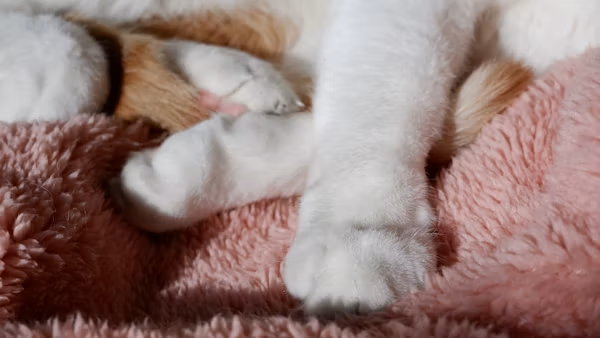
There is something almost impossible to ignore when a cat settles down on a soft blanket, starts pushing its paws in and out, and suddenly begins to purr.
It looks peaceful. A little funny, too.
Sometimes they do it for several minutes, completely absorbed in their own little ritual. You may even wonder if your cat is trying to make the blanket more comfortable before taking a nap.
But why the blanket? And why does the purring usually start at the same time?
If your cat kneads your blanket and purrs, there is usually nothing strange about it. In fact, this combination of behaviors can tell you quite a bit about how your cat feels in that moment.
Why Do Cats Knead Blankets?
Kneading is one of those cat behaviors that seems to have no obvious explanation until you look at where it comes from.
A kitten kneads its mother’s belly with its paws while nursing. The movement is associated with feeding and comfort during the earliest part of a cat’s life.
Adult cats may continue the behavior long after they no longer need to nurse.
That is why kneading can become a comforting habit.
A blanket is also the perfect surface for it. It is soft, warm, and easy for a cat to press its paws into. Some cats knead pillows, beds, clothing, or even their owner’s lap.
So when your cat chooses a blanket, it may simply be choosing the surface that feels best for this familiar behavior.
Why Does My Cat Purr While Kneading?
This is where the two behaviors become especially interesting.
Kneading and purring often appear together because both can be connected with relaxation and comfort.
Think about what is happening from your cat’s perspective.
It has found a soft place. It is comfortable. It feels safe enough to settle down. Then it begins making the same rhythmic paw movement that has been associated with comfort since kittenhood.
The purring may simply be another expression of that relaxed state.
Of course, purring does not always mean a cat is happy. Cats can also purr when they are stressed, frightened, or uncomfortable. Context matters.
But if your cat is lying on a cozy blanket, slowly kneading it, looking relaxed, and purring softly, there is a good chance you are watching a very content cat.
Is My Cat Remembering Being a Kitten?
Possibly, although we cannot know exactly what a cat is thinking.
Kneading is believed to be a behavior that carries over from kittenhood. The movement itself may have become associated with nursing, warmth, and security.
That does not necessarily mean your adult cat is consciously remembering its mother.
It is more accurate to think of kneading as a behavior that became associated with comfort very early in life and remained useful or soothing later on.
This may explain why some cats seem particularly attached to kneading when they are sleepy.
The blanket becomes part of the ritual.
Soft surface. Paw movements. Purring. Then sleep.
It is almost like your cat has created its own bedtime routine.
Why Does My Cat Knead Only Certain Blankets?
Cats can be surprisingly selective about texture.
You may have several blankets in the house, but your cat may completely ignore most of them and repeatedly choose one particular blanket.
That can come down to how the material feels under the paws.
A thick fleece blanket, a fluffy throw, or a soft comforter can provide the resistance a cat seems to enjoy while kneading. The smell may also matter.
Cats experience their surroundings through scent in ways we often underestimate.
If a blanket carries your scent, your cat may find it especially familiar and comforting.
So if your cat always chooses the blanket on your bed, it may not be random at all.
The blanket could simply be the perfect combination of softness, warmth, familiarity, and your scent.
Why Does My Cat Knead Me and Not Just the Blanket?
Some cats take the behavior one step further.
Instead of kneading a blanket, they knead their owner’s legs, stomach, chest, or lap.
It can be adorable.
It can also be surprisingly painful when sharp claws are involved.
But when a cat kneads you while purring, it may be showing that it feels comfortable around you.
Cats use scent and physical contact to interact with their environment. Their paws also contain scent glands, so kneading may have a marking component as well.
That does not mean your cat is deliberately thinking, “This human belongs to me.”
It is simply another way cats interact with familiar people and spaces.
If your cat chooses your lap over an entire sofa full of blankets, however, you can probably take it as a compliment.
Does Kneading Mean My Cat Is Happy?
Often, yes—but the surrounding behavior matters.
A relaxed cat may knead while:
- purring softly
- keeping its eyes partially closed
- lying comfortably
- stretching its paws rhythmically
- settling down for a nap
- showing relaxed body language
When these signs appear together, kneading is usually part of a comfortable and peaceful moment.
But it is important not to treat one behavior as a perfect emotional translation.
Cats can purr for different reasons, and kneading can also happen in situations that are not simply about happiness.
The best way to understand what your cat is feeling is to look at the entire picture.
Why Does My Cat Knead Before Going to Sleep?
You may notice that kneading happens right before your cat settles down.
That makes sense when you consider how closely the behavior is connected with comfort.
Your cat may have developed a little routine:
Find a soft place.
Knead it.
Purr.
Circle around.
Lie down.
Sleep.
Some cats repeat this routine almost every night.
There is something wonderfully ordinary about it. While humans have complicated bedtime rituals, cats sometimes seem satisfied with a blanket and a few rhythmic paw movements.
And if the blanket happens to be yours, apparently that is even better.
Should I Stop My Cat From Kneading?
Usually, there is no reason to stop a cat from kneading if the behavior is harmless.
Kneading is a normal behavior for many cats, and allowing your cat to have a comfortable place to do it can be a simple way of letting it relax.
The main problem is usually the claws.
If your cat kneads your lap and accidentally turns a peaceful moment into a painful one, you do not have to simply tolerate it.
You can gently place a thick blanket between your cat and your skin.
You can also redirect your cat toward a soft blanket or cushion.
There is no need to punish the cat for kneading. The behavior itself is not bad.
It is simply one of those moments when a cat’s idea of affection and a human’s idea of comfort do not always line up perfectly.
What If My Cat Kneads and Purrs Excessively?
Kneading and purring by themselves are generally not a reason to worry.
What matters is whether anything else has changed.
If your cat suddenly starts behaving very differently, seems restless, hides more than usual, stops eating, vocalizes unusually, or shows signs of pain or illness, the change deserves attention.
A behavior that has always been part of your cat’s routine is very different from a sudden and unusual change in behavior.
So instead of asking whether kneading is “normal” in isolation, look at your cat as a whole.
Is your cat eating normally?
Sleeping normally?
Playing?
Using the litter box normally?
Interacting with you normally?
If everything else seems fine and your cat simply loves kneading its favorite blanket while purring, there is usually no mystery that needs solving.
Your cat may just be enjoying itself.
The Connection Between Kneading and Purring
Kneading and purring are two behaviors that can make a cat’s comfort especially easy to recognize.
One is physical and rhythmic.
The other is a soft sound that often accompanies relaxed moments.
Together, they create one of those unmistakable cat scenes: paws moving slowly against a blanket while the cat settles into a comfortable position and purrs away.
If you have ever wondered why your cat seems to become completely absorbed in this little ritual, the simplest explanation may be the best one.
It feels good.
It is familiar.
And it is safe.
If you are also curious about why cats purr in the first place, you can read [Why Does My Cat Purr So Much?] to explore the different reasons behind this fascinating behavior.
So, Why Does My Cat Knead My Blanket and Purr?
When your cat kneads a blanket and purrs, it is usually combining two familiar behaviors associated with comfort and relaxation.
Kneading may have roots in kittenhood, when kittens pressed their paws against their mother’s belly while nursing. As adult cats, many continue the movement because it remains soothing or simply feels natural.
The purring can accompany that relaxed state, especially when your cat is comfortable, warm, and ready to rest.
So the next time you find your cat happily kneading a blanket, there may be no complicated explanation.
Your cat found a soft spot, started making biscuits, turned on the purr machine, and decided that this was the perfect place to be.
Honestly, it sounds like a pretty good evening.