
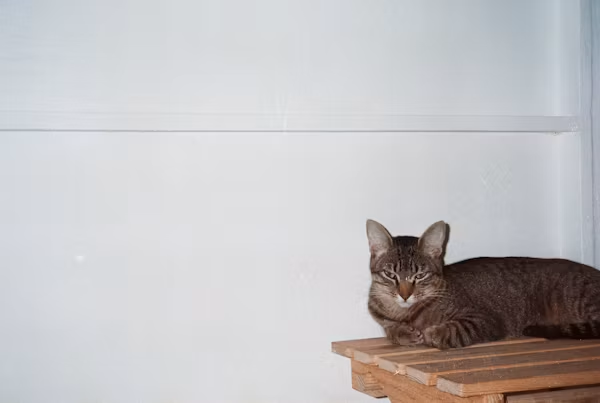
Some cats seem to have a built-in motor. They purr when you pet them, when they curl up on the sofa, and sometimes for no obvious reason at all.
Then there are cats that barely make a sound.
If your cat almost never purrs, you may eventually start wondering: Why does my cat not purr?
The good news is that a quiet cat is not necessarily an unhappy cat. Cats have different personalities, different ways of communicating, and different levels of vocalization. Some simply do not purr very often, while others may purr so quietly that you can barely hear it.
So before assuming something is wrong, it helps to look at the bigger picture.
Some Cats Simply Do Not Purr Very Often
The first thing to remember is that not every cat is a frequent purrer.
Just as some cats are extremely vocal while others rarely meow, purring habits can vary too.
Your cat may be perfectly comfortable and still spend most of its life without making that familiar vibrating sound.
If your cat has always been quiet and continues to eat, play, sleep, groom itself, and interact normally, its lack of purring may simply be part of its personality.
There is no rule saying that every happy cat has to purr constantly.
Your Cat May Purr So Quietly That You Cannot Hear It
Sometimes the problem is not that your cat does not purr.
You simply cannot hear it.
Some cats have very soft purrs. You might notice a tiny vibration when you place your hand gently against your cat’s neck or chest, even though there is almost no sound.
This can be especially difficult to notice in a noisy room.
Try paying attention when your cat is completely relaxed and the house is quiet.
You may discover that your supposedly non-purring cat has actually been purring all along.
Cats Have Different Ways of Showing Affection
Not every cat expresses affection through purring.
Your cat may show that it trusts you in other ways.
Maybe it follows you from room to room. Maybe it sleeps beside you. Maybe it sits near you while you work or watches you from across the room.
Some cats also show affection by rubbing against their people, gently touching them with their paws, or licking you.
These behaviors can tell you a lot about your relationship with your cat, even if you rarely hear a purr.
Why Does My Cat Never Purr Around Me?
If your cat does not purr around you, it does not necessarily mean that your cat dislikes you.
Cats can have very different preferences when it comes to physical affection.
Some love being touched and immediately start purring. Others prefer sitting nearby without being handled.
Your cat may feel completely safe with you while expressing that comfort through proximity rather than sound.
Instead of asking only whether your cat purrs, look at what it does when it is around you.
Does it choose to stay close?
Does it approach you voluntarily?
Does it relax in your presence?
Does it sleep comfortably near you?
Those behaviors may be more informative than the absence of a purr.
Some Cats Purr Only in Certain Situations
You may also have a cat that does purr, but only under very specific circumstances.
Perhaps it purrs when you wake up in the morning.
Maybe it purrs when it is eating.
Perhaps it only happens when your cat is curled up in its favorite blanket.
Or maybe your cat saves its purring for moments when the house is completely quiet.
If you rarely hear your cat purr, it can be easy to assume it never does.
But cats do not always repeat the same behavior in every situation.
Pay attention to when your cat seems most relaxed. That may be when the purring finally appears.
Why Does My Cat Stop Purring?
This is slightly different from having a cat that has never been a big purrer.
If your cat used to purr regularly and suddenly stops, it is worth paying attention to the change.
A change in behavior can sometimes be more meaningful than the behavior itself.
Think about what else has changed.
Is your cat hiding more?
Has its appetite changed?
Is it less interested in playing?
Does it seem uncomfortable when you touch it?
Is it sleeping much more than usual?
Has it stopped interacting with you?
A sudden change accompanied by other unusual behaviors deserves more attention. Veterinary guidance notes that cats can hide signs of illness, so noticeable changes in their normal behavior should not simply be ignored.
Can a Cat Be Happy Without Purring?
Absolutely.
Purring is only one form of feline communication.
A cat can be comfortable, confident, and attached to its person without being a loud purrer.
Imagine two cats living in the same house.
One jumps onto the sofa, curls beside you, and immediately starts purring.
The other walks over, sits beside you, closes its eyes, and quietly stays there.
They may both be perfectly content.
They simply have different ways of showing it.
This is one reason it is so useful to learn your own cat’s normal personality instead of comparing it with other cats.
Why Does My Kitten Not Purr?
Kittens can also vary in how much they purr.
You may notice some kittens making the sound almost immediately, while others are much quieter.
A kitten’s behavior can change as it grows, and its communication style may become easier to recognize over time.
Rather than focusing on whether the kitten purrs, look at the whole picture.
Is it feeding normally?
Is it active when it should be?
Does it interact normally?
Does it appear comfortable?
If you have concerns about a young kitten’s behavior or development, a veterinarian can help you understand what is normal for that individual animal.
Is It Possible to Teach a Cat to Purr?
Not really.
Purring is not something you need to teach your cat.
If your cat naturally purrs, you may notice that certain situations encourage it, such as gentle petting, resting in a favorite place, or being close to someone it trusts.
But trying to make a cat purr is unlikely to be useful.
Instead, focus on creating an environment where your cat feels safe enough to behave naturally.
Sometimes the best way to build trust with a cat is to let the cat decide when and how it wants to interact.
Should I Be Worried If My Cat Never Purrs?
Usually, the absence of purring by itself is not a reason to panic.
If your cat has always been quiet and otherwise seems healthy and comfortable, it may simply be a cat that does not purr very much.
The more important question is whether there has been a change from your cat’s normal behavior.
A cat that has never been a purrer is different from a cat that suddenly stops purring and also begins hiding, eating less, moving differently, or showing other unusual signs.
Cats can hide discomfort surprisingly well, which is why sudden behavioral changes deserve attention.
If something about your cat seems noticeably different, a veterinarian is the best person to help determine what may be happening.
What If My Cat Is Happy But Never Purrs?
Your cat may simply have chosen a different way to show it.
Maybe happiness looks like following you around the house.
Maybe it looks like sleeping beside you.
Maybe it is sitting near you while you read, watching you quietly.
Or maybe your cat greets you at the door, rubs against your legs, and then walks away as if nothing happened.
Cats are not always obvious about their feelings.
That is part of what makes living with them so interesting.
Look at the Whole Cat, Not Just the Purr
So, why does your cat not purr?
It may be because your cat naturally purrs very little. It may have an extremely quiet purr that you rarely notice. Or it may simply prefer other ways of communicating comfort and affection.
The absence of a purr does not automatically mean the absence of happiness.
Instead, pay attention to the complete picture.
A relaxed body, normal appetite, regular grooming, playful moments, comfortable sleep, and a willingness to interact can all tell you more about your cat’s well-being than one particular sound.
And if your cat has never been much of a purrer, there may be nothing to fix.
You may simply have a quieter cat.
Not every cat needs to sound like a tiny motor to let you know it feels at home.