
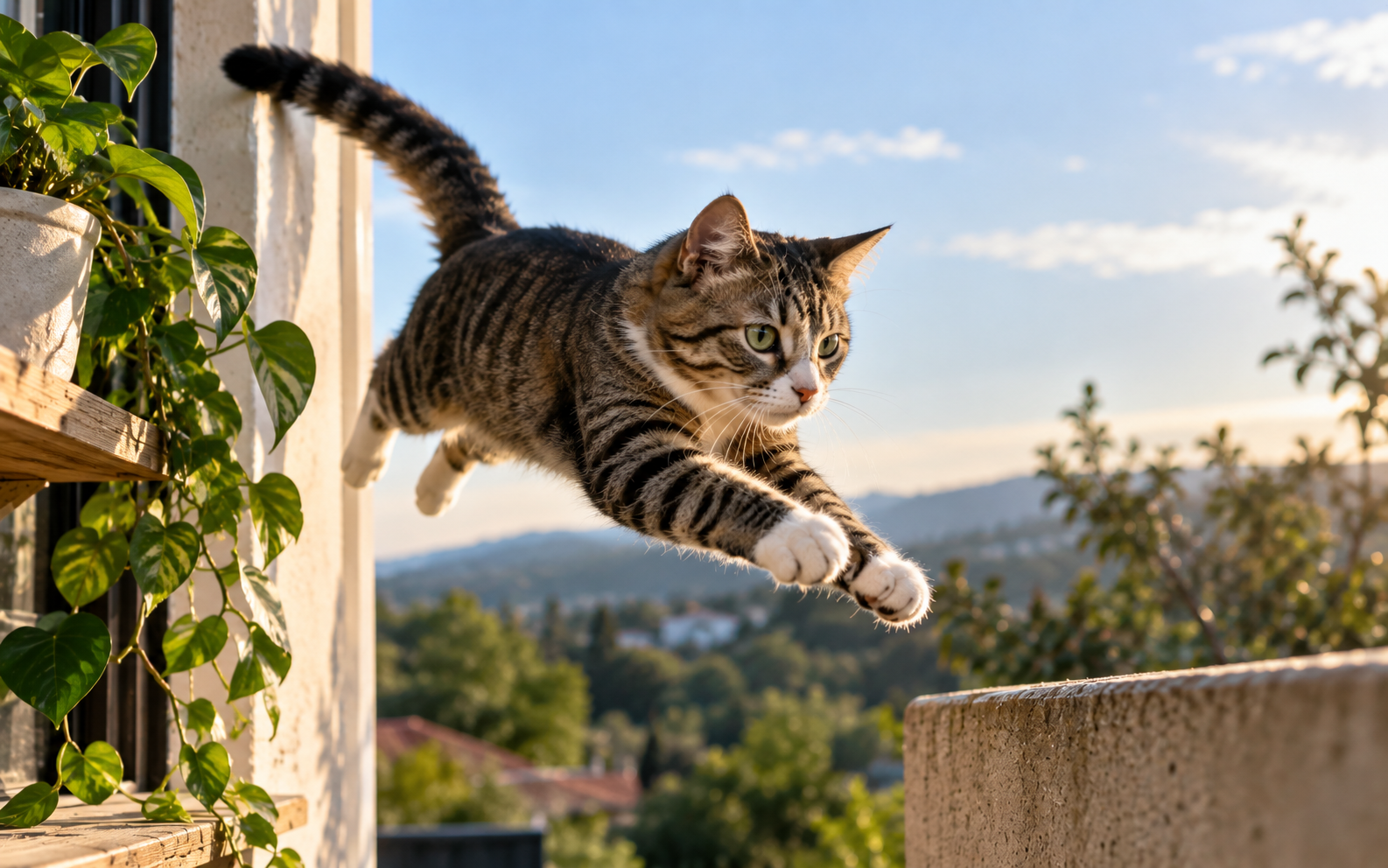
There are moments when living with a cat feels like watching a small creature from another world. One minute, a cat is stretched out in a patch of sunlight, barely moving. The next, it has jumped onto a high shelf, slipped through a narrow opening, or landed on its feet with an ease that seems almost impossible.
Cats may spend much of the day sleeping, but their bodies and senses are remarkably capable. They can hear sounds humans cannot, move with extraordinary precision, maintain impressive balance, and use their whiskers to gather information about the world around them.
Some of these abilities come from anatomy. Others come from instinct, flexibility, and thousands of years of adaptation.
So, what can cats do that makes them so remarkable?
Cats Have Abilities That Seem Almost Superhuman
Cats are natural athletes, even when they do not look particularly athletic.
Their bodies are designed for movement. A flexible spine, strong hind legs, sharp claws, sensitive whiskers, and highly developed senses all work together to help them navigate their surroundings.
This combination allows cats to do things that can seem extraordinary to us.
They can:
- Jump surprisingly high
- Land with remarkable accuracy
- Balance on narrow surfaces
- Change the position of their bodies quickly
- Hear sounds from much farther away than humans can
- Move through surprisingly small spaces
- Detect subtle movements around them
- Use their tails to help with balance
- Communicate through sounds and body language
What looks like a little act of feline magic usually has a very practical explanation.
Their Senses Are Far More Powerful Than Ours
One of the greatest abilities cats have is something humans often overlook: their senses are highly adapted to detecting their surroundings.
Cats Have Excellent Hearing
A cat can detect a much wider range of frequencies than a human can. Its ears can also rotate toward sounds, helping it determine where a noise is coming from.
That is one reason a cat may suddenly turn its head toward something that seems completely silent to everyone else in the room.
A tiny movement behind a door, a faint sound outside, or the noise of a small animal can capture a cat’s attention almost instantly.
Cats Have Highly Sensitive Whiskers
Whiskers are not simply decorative hairs around a cat’s face.
They are extremely sensitive structures that help cats gather information about their environment. They can help detect nearby objects, changes in air movement, and whether an opening may be large enough for the cat’s body.
This becomes especially useful when a cat is exploring a dark or unfamiliar space.
Cats Have Remarkable Vision
Cats are particularly well adapted to seeing in low-light conditions.
Their eyes allow them to make better use of available light than human eyes can. This helps explain why cats can remain active around dawn, dusk, and other periods when the environment is relatively dim.
However, cats do not see in complete darkness. They still need at least some available light.
Cats Can Move With Incredible Precision
Watching a cat jump from one surface to another can make the movement look effortless.
Behind that effortless appearance is a combination of muscular strength, flexibility, balance, and rapid reflexes.
Cats Are Excellent Jumpers
A cat can use its powerful hind legs to propel itself upward and forward.
Its body then adjusts during the movement to help it reach the intended landing point.
This ability is useful for climbing, escaping danger, reaching elevated resting places, and navigating environments filled with obstacles.
Cats Have Extraordinary Balance
Cats are remarkably comfortable walking along narrow surfaces.
Their tails can contribute to balance, while their flexible bodies allow them to make small adjustments as they move.
This is why a cat can sometimes walk along the edge of furniture or another narrow surface as though it were a perfectly ordinary path.
Cats Have a Righting Reflex
Perhaps one of the most fascinating feline abilities is the ability to reorient the body during a fall.
Cats have what is known as a righting reflex, which helps them adjust their bodies so they can orient their feet toward the ground.
This does not mean cats are immune to injury. Falls can still be dangerous, especially from significant heights.
But the ability itself is an extraordinary example of feline coordination and body control.
Cats Can Fit Into Surprisingly Small Spaces
If you have ever wondered how a cat managed to squeeze itself into a space that looked far too small, you are not alone.
Cats have flexible bodies and relatively mobile shoulders, which contribute to their ability to move through narrow spaces.
Their whiskers can also provide information about nearby objects and the space around their heads.
This flexibility is useful in natural environments, where cats may need to move through vegetation, narrow passages, or places where prey or shelter can be found.
For domestic cats, however, this ability often translates into something much simpler:
If there is a box that looks slightly too small, a cat may decide it is the perfect place to sleep.
Cats Can Communicate in More Ways Than Meowing
Another impressive thing cats can do is communicate without relying entirely on sound.
A cat’s body can tell us a great deal about what it may be experiencing.
The position of the ears, movement of the tail, posture, facial expression, and even the way a cat approaches another animal or person can provide clues about its state.
The Tail Can Say a Lot
A cat’s tail can change position depending on the situation.
A raised tail may accompany a friendly approach, while a rapidly moving or puffed-up tail can signal a very different emotional state.
The important thing is to consider the whole body, rather than interpreting one movement in isolation.
Cats Use Different Sounds
Meowing is only one part of feline communication.
Cats may also use purring, chirping, trilling, hissing, growling, and other vocalizations.
Interestingly, domestic cats can develop different vocal habits depending on their experiences and interactions with humans.
Over time, people often become surprisingly good at recognizing the sounds their own cats make.
Some Cat Behaviors Reveal Remarkable Instincts
Cats can also perform behaviors that seem mysterious because they are strongly influenced by instinct.
For example, a cat may suddenly become intensely interested in a moving object, crouch low before jumping, or carefully observe something from a distance.
These behaviors are connected to the way cats interact with their environment.
Even a house cat that has never needed to hunt for food can still display behaviors associated with stalking, chasing, pouncing, and observing movement. Cat enrichment can provide safe ways for them to express some of these natural behaviors.
This is one reason a simple toy can become so fascinating.
To the cat, movement itself can be stimulating.
Why Do Cats Have These Amazing Abilities?
Most of these abilities are not random.
Cats evolved as predators that needed to move efficiently, detect subtle sounds and movements, remain aware of their surroundings, and react quickly.
Their ancestors benefited from being able to:
- Move quietly
- Detect potential prey
- Avoid threats
- Climb and navigate different environments
- Maintain balance
- React quickly to sudden movement
Domestic cats may now live comfortably indoors, but much of that physical equipment remains.
The result is an animal that can spend an afternoon sleeping on a sofa and still possess the body of a remarkably capable predator.
What Makes Cats So Adaptable?
Perhaps the most impressive thing about cats is not one particular ability.
It is the way several abilities work together.
A cat does not simply have good hearing. It combines hearing with vision, smell, whisker sensitivity, balance, flexibility, and rapid reflexes.
That combination allows it to respond to its surroundings in ways that can seem almost effortless.
It also explains why cats can adapt to many different environments, from homes and apartments to farms and outdoor spaces.
They are curious, cautious, athletic, and observant animals.
And sometimes, they are simply very good at finding the warmest spot in the house.
Final Thoughts
Cats may look relaxed most of the time, but beneath that calm exterior is an animal with an extraordinary collection of abilities.
They can hear subtle sounds, navigate narrow spaces, jump with precision, maintain impressive balance, communicate through their bodies and voices, and react quickly to changes around them.
What looks like a cat being mysterious or even a little magical is often the result of remarkable anatomy and instinct.
Maybe that is part of what makes living with cats so fascinating.
They can spend hours doing absolutely nothing — and then suddenly remind us how capable they really are.