
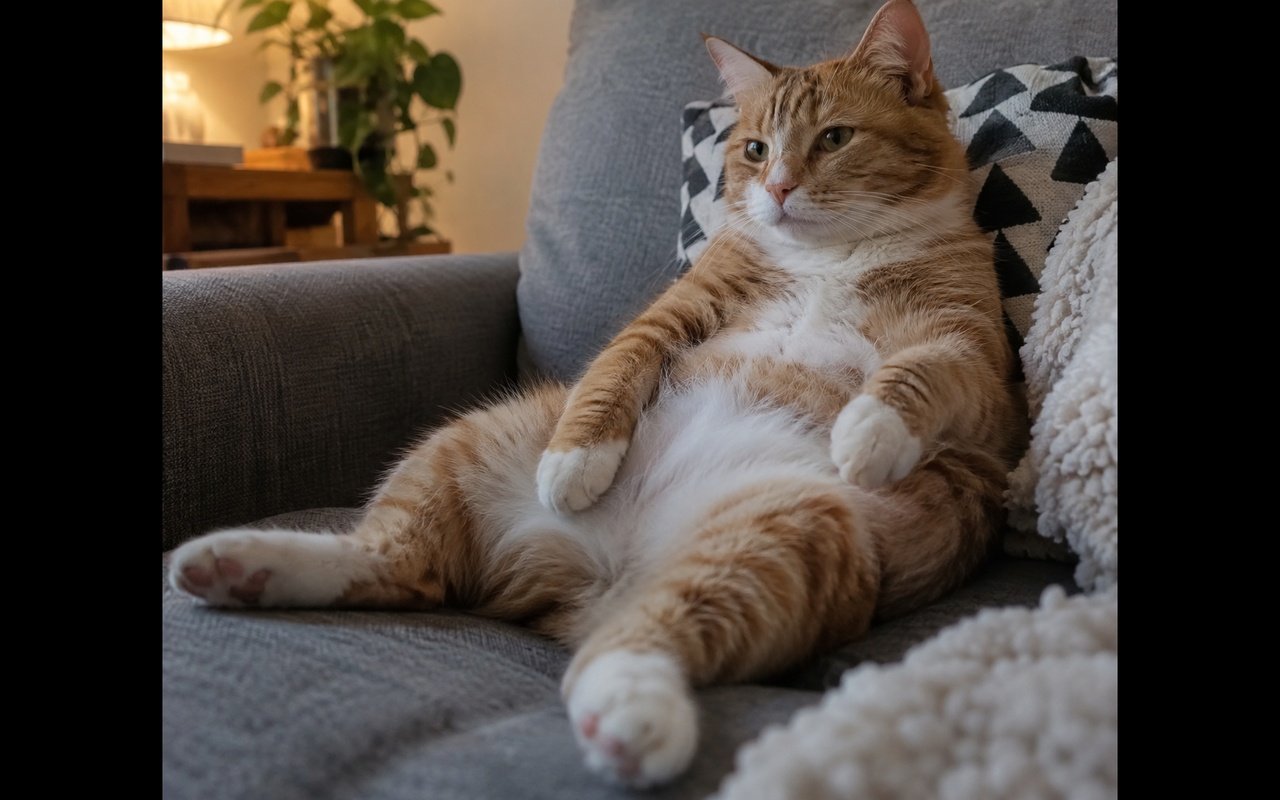
Sometimes a cat can make you stop in the middle of whatever you are doing and stare.
There it is, sitting upright on the couch with its paws resting on its belly. Or perhaps it is stretched across the bed with its head on the pillow, watching television beside you as if it has been part of the household forever.
Then there are the cats that follow their humans from room to room, insist on sitting beside them while they work, respond when spoken to, or seem to have developed an entire schedule around the people they live with.
It can be hard not to wonder: why do cats act like humans sometimes?
Cats certainly have a talent for making ordinary behaviors look surprisingly human. But the explanation is usually more interesting than simply saying that cats copy us.
Cats have their own instincts, ways of communicating, preferences, and social behaviors. At the same time, living closely with humans gives them many opportunities to learn routines, recognize signals, and adapt their behavior to the environment around them.
That combination can create some remarkably human-like moments.
Why Do Cats Sometimes Seem So Human?
When a cat behaves in a way that resembles something a person would do, it is natural for us to interpret the behavior through a human perspective.
A cat sitting at the table looks as though it is joining the family for dinner.
A cat lying on a pillow looks as though it is getting ready for bed.
A cat following someone around the house can look like a little companion who simply wants to be part of everything.
But cats do not necessarily attach the same meaning to these actions that humans do.
Instead, their behavior is shaped by their own needs and experiences.
A cat may sit on a chair because it is comfortable, warm, elevated, or positioned in a place where the cat can observe the room. A cat may sleep on a pillow because it is soft and carries a familiar scent. A cat may follow a person because that person provides food, attention, security, companionship, or simply interesting things to investigate.
The human-looking part comes from the way the behavior appears to us.
Still, there is something important happening underneath it.
Cats are observant animals, and they can learn about the people they live with. They become familiar with voices, routines, movements, and patterns inside the home.
That is one reason their behavior can sometimes feel almost uncannily human.
Why Does My Cat Sit Like a Human?
Few cat behaviors produce as many amused reactions as the famous “human sitting position.”
Some cats sit upright with their backs against furniture and their hind legs stretched forward. Others rest their paws over their stomachs or lean against a cushion in a way that looks almost exactly like a person relaxing.
It may look as though the cat has decided to take a seat like everyone else.
Usually, however, the explanation is much simpler.
Cats are extremely flexible animals. They can rest, stretch, groom themselves, and observe their surroundings in many different positions.
An upright posture can simply be comfortable.
It can also give a cat a good view of what is happening around it. Cats naturally pay attention to movement and changes in their environment, so a comfortable position with a clear view can be useful.
Grooming can also create some of these funny-looking poses.
When a cat sits upright while cleaning its body, the position may look deliberate and human to us. To the cat, it is simply part of normal feline behavior.
The same thing happens when cats stretch their legs, lean against furniture, or curl themselves into positions that would probably leave a human reaching for a chiropractor.
So if your cat sits like a tiny person, there may be no secret explanation at all.
It may simply have found a comfortable way to be a cat.
Cats May Learn From the People Around Them
Living with humans gives cats a huge amount of information to process.
Every day follows patterns.
People wake up, prepare food, leave the house, return home, sit down, go to sleep, and repeat familiar activities. Cats observe these routines over and over again.
Eventually, many cats learn what those routines predict.
The sound of a food container can mean breakfast.
The movement toward a particular room can mean playtime.
A person picking up a blanket may signal that the sofa is about to become a comfortable place to rest.
A familiar sound at the front door may mean that someone is coming home.
This kind of learning does not necessarily mean that a cat is deliberately imitating a human.
It can happen through association.
The cat experiences an event repeatedly and learns what tends to happen next.
This is one reason cats can appear to understand household routines so well.
Research into feline behavior has also explored whether cats can learn by watching humans. The results are more complicated than the popular idea that cats simply copy everything we do.
Some research has found evidence that cats can reproduce demonstrated actions under particular conditions, while other experimental work has not found evidence that cats automatically learn a new task simply by watching a human perform it.
That means it is better to think of cats as capable observers and learners rather than assuming that every human-like behavior is imitation.
Sometimes the cat is learning.
Sometimes it is responding to a familiar routine.
And sometimes it is simply doing something that happens to look human.
Some “Human” Behaviors Are Actually Natural Cat Behaviors
A surprising number of behaviors that look human have perfectly natural feline explanations.
Take sleeping in a bed.
A cat that climbs under the covers or settles against a pillow may look as though it has adopted the human bedtime routine. But beds offer several things cats naturally appreciate: warmth, softness, security, and familiar smells. This is also where cat enrichment can become useful, giving cats appropriate ways to explore and express their natural behaviors
The same applies to sitting on furniture.
A sofa is comfortable. A chair can provide elevation. A desk can offer an excellent place from which to watch a person, a window, or the entire room.
Then there is following.
A cat that follows its human into the kitchen, bedroom, bathroom, and hallway may seem unusually attached. But curiosity, social interaction, routine, and the expectation of food or attention can all play a role.
Even some behaviors that seem emotional or sentimental have feline roots.
Kneading, for example, is often associated with early kittenhood and comfort. When an adult cat kneads a blanket or a person’s lap, the behavior may look like a small ritual created especially for its favorite human.
It is easy to give these behaviors human explanations because they happen inside a human environment.
But understanding them as cat behaviors makes them no less meaningful.
Why Do Cats Seek Attention and Companionship?
One of the biggest reasons cats can appear human-like is their ability to develop relationships with people.
Although cats are often described as solitary or independent animals, many domestic cats actively seek interaction with their humans.
They may sit beside someone while they work.
They may wait near a door.
They may sleep close to a particular person.
They may vocalize when someone enters the room.
Some cats even seem to have a preferred person in the household.
These behaviors can become especially noticeable when a cat learns that a certain human responds consistently.
For example, if a cat meows and receives attention, the behavior may become part of its communication with that person.
If sitting beside someone leads to petting, the cat may repeat the behavior.
If following someone into the kitchen sometimes results in food, the cat has another reason to make that journey.
Over time, cats and humans can develop their own patterns of interaction.
That can make the relationship feel surprisingly conversational.
The cat does something.
The human responds.
The cat adjusts.
The human learns what the cat wants.
Eventually, both sides become familiar with the other’s habits.
Cats Can Adapt Their Behavior to Their Humans
Every household has a different rhythm, and cats become part of that rhythm.
A cat living with someone who works from home may spend much of the day nearby.
A cat whose human leaves the house every morning may become accustomed to a quieter daytime routine and become more active when the person returns.
Some cats seem to know when their humans are about to wake up.
Others recognize the sounds associated with meals, bedtime, or leaving the house.
This does not necessarily mean that the cat is copying the human’s lifestyle.
Instead, the cat is learning the environment.
Cats are sensitive to patterns, and predictable routines can become an important part of their daily lives.
Human behavior can also influence how a cat behaves during interactions.
The tone of a person’s voice, their movements, the way they approach the cat, and whether they consistently respond to the animal can all shape future interactions.
This is one reason two cats living in different households can develop very different personalities and habits.
Their individual temperament matters, but so does the world they experience every day.
Do Cats Really Think They Are Human?
Probably not.
There is no good evidence that cats literally believe they are human simply because they live with people or display human-like behaviors.
The idea is entertaining, especially when a cat sits at the dinner table looking deeply unimpressed by the menu.
But the reality is more interesting.
Cats have their own sensory world and their own ways of understanding their surroundings. They can recognize familiar humans, learn associations, respond to signals, and develop social relationships without needing to think of themselves as people.
A cat sleeping on a person’s pillow does not need to believe it is human.
The pillow is simply comfortable.
A cat sitting beside a laptop does not need to understand work.
The laptop may be interesting, the person may provide attention, and the desk may offer a convenient place to sit.
A cat following its owner does not need to think like a human companion.
The person may simply be an important and familiar part of the cat’s environment.
So the better question may not be whether cats think they are human.
It may be how well they have learned to live alongside us.
Why Do Some Cats Seem More Human Than Others?
Not every cat behaves in the same way.
Some cats are constantly involved in household activities. They want to inspect every bag, sit beside every visitor, and investigate anything their humans touch.
Others are much more reserved.
They may prefer a quiet corner, interact on their own terms, and disappear whenever the household becomes busy.
Individual personality plays a role.
Early experiences, environment, socialization, and the relationship a cat develops with its humans can also influence behavior.
This explains why one cat may follow its owner everywhere while another seems perfectly content to observe from a distance.
Neither behavior necessarily means that one cat is more intelligent or more affectionate.
They may simply have different temperaments and different preferences.
That individuality is part of what makes living with cats so unpredictable.
When Human-Like Cat Behavior Is Completely Normal
Most behaviors that make a cat look strangely human are simply normal variations of feline behavior.
Sitting upright.
Sleeping in unusual positions.
Following someone around the house.
Watching people closely.
Waiting beside a person while they work.
Seeking attention at particular times.
Responding to familiar routines.
Even appearing to “talk back” when spoken to.
These behaviors can all become part of a healthy relationship between a cat and its household.
The important thing is to consider the entire context.
If a behavior is familiar, consistent, and not accompanied by signs of distress, it is often simply part of that cat’s personality and routine.
What looks unusual to one person may be completely ordinary for another cat.
And sometimes the funniest behaviors are simply individual quirks that make a particular cat memorable.
What These Behaviors Can Tell You About Your Cat
The next time your cat does something that looks suspiciously human, try looking at the situation from the cat’s perspective.
Ask a few simple questions.
Is the behavior connected to a routine?
Does the cat usually receive attention afterward?
Is the position comfortable?
Is the cat watching something?
Does the behavior happen around a particular person?
Did the behavior develop gradually?
Is the cat responding to something that happened immediately before it?
These questions can reveal more than simply saying, “My cat is acting like a human.”
Perhaps the cat has learned a household routine.
Perhaps it has discovered that a particular behavior gets attention.
Perhaps it is responding to a familiar human signal.
Or perhaps it has simply found the best seat in the house.
Sometimes several explanations can be true at the same time.
And that is what makes these behaviors so fascinating.
Cats do not need to think like humans to become deeply connected to human life.
They learn our schedules, recognize our voices, respond to our movements, and develop their own ways of getting our attention.
In doing so, they become surprisingly good at fitting themselves into our world.
Final Thoughts
Cats sometimes act so much like humans that it is almost impossible not to laugh.
They sit on chairs like tiny people, sleep on our pillows, follow us around the house, interrupt our work, and seem to know exactly when we are about to give them attention.
But these behaviors do not mean that cats have forgotten that they are cats.
They have simply become remarkably adaptable companions.
Their instincts, individual personalities, learning abilities, and relationships with humans all come together inside the same household.
So the next time your cat sits beside you as though it has something important to discuss, there may be no need to decide whether it is acting like a human.
Maybe it has simply become very good at being a cat in a human world.