
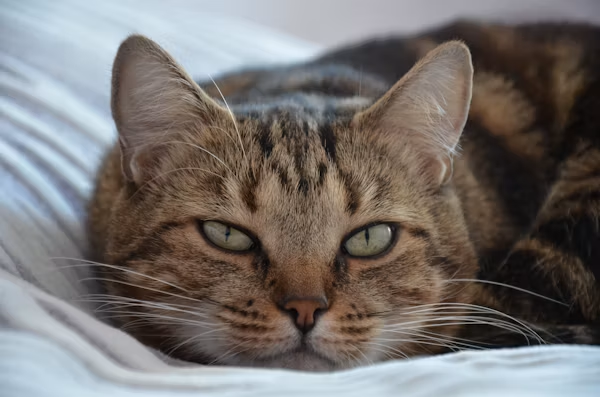
Some cats seem to have a tiny engine inside them.
You sit next to your cat and hear a soft little purr. Then you start petting it, and suddenly the sound gets much louder. Sometimes you can even feel the vibration through your hand.
It can make you wonder: Why does my cat purr so loud?
A loud purr does not necessarily mean that something is wrong. Cats have different personalities, different voices, and different ways of expressing themselves. Some simply have a much more noticeable purr than others.
But the situation matters too.
A cat that has always had a loud purr is very different from a cat whose purring suddenly becomes louder or more frequent.
Some Cats Simply Have Loud Purrs
The simplest explanation may be that your cat is naturally a loud purrer.
Just as some cats are very vocal while others are quiet, the volume of a cat’s purr can vary from one individual to another.
You may have a cat whose purr is barely audible unless the room is completely silent. Another cat may sound like a small motor every time it settles beside you.
Neither one is necessarily unusual.
If your cat has always purred loudly and otherwise behaves normally, its powerful purr may simply be part of its personality.
Your Cat May Be Very Relaxed
A loud purr can happen when a cat is completely comfortable.
Imagine your cat curled up on a favorite blanket, eyes half closed, body loose, and enjoying a gentle pet.
That is a situation where a louder purr may simply reflect relaxation and contentment.
Some cats seem to turn up the volume when they are especially comfortable.
You may notice this after your cat finds a warm sleeping spot, settles beside you, or gets the kind of affection it enjoys.
Your Cat May Purr More When You Pet It
Have you ever noticed that your cat’s purr gets louder the moment you start scratching its favorite spot?
That can happen because physical contact is part of the experience your cat enjoys.
Some cats respond to petting with a barely noticeable vibration. Others immediately start producing a much stronger sound.
Pay attention to your cat’s body language.
If it leans toward your hand, relaxes its body, closes its eyes, or stays comfortably beside you, the louder purring may simply be part of an enjoyable interaction.
And if your cat shows affection in other ways, such as licking you, that can be another part of the bond you have developed together.
Some Cats Have Naturally Stronger Purring
There is no universal volume setting for a cat’s purr.
Individual cats can differ considerably in how noticeable their purring is. Breed, personality, age, body size, and even the situation can influence how the sound seems to you.
You may also notice that a cat’s purr sounds louder when its body is close to you.
A cat lying directly against your chest or beside your head can sound much louder than the same cat purring several feet away.
Sometimes the difference is not actually the purr itself.
It is simply the distance.
Why Does My Cat Purr Loudly When I Come Home?
If your cat starts purring loudly when you return home, it may be responding to the excitement of seeing you again.
Cats can develop strong routines with the people they live with.
Your arrival may mean food, attention, play, petting, or simply the return of a familiar person.
The purring may be part of that social interaction.
You may even notice your cat combining purring with other behaviors, such as rubbing against your legs, following you around the house, or jumping onto the furniture beside you.
Together, these behaviors can tell you much more than the volume of the purr alone.
Why Does My Cat Purr Loudly When It Sleeps?
Some cats are surprisingly noisy sleepers.
Your cat may curl up in its favorite spot, close its eyes, and begin purring loudly while resting.
If this is a normal habit for your cat, there may be nothing unusual about it.
The sound can also seem louder at night because the house is quiet.
During the day, you may have conversations, television, appliances, traffic, and other background sounds competing with your cat’s purr.
At night, that little motor suddenly has the whole room to itself.
Can a Loud Purr Mean My Cat Is Happy?
It can.
A cat that is relaxed, comfortable, seeking affection, and showing loose, calm body language may be purring because it feels good.
But it is better not to use purring alone as a measurement of happiness.
Cats can purr in different situations, and the rest of their behavior provides important clues.
A relaxed cat that is eating normally, playing, grooming, sleeping comfortably, and interacting as usual is giving you a very different picture from a cat that is suddenly behaving differently.
The purr is only one piece of the puzzle.
What If My Cat’s Purr Suddenly Gets Louder?
This is where it is worth paying closer attention.
If your cat has always had a loud purr, that is probably just part of its normal behavior.
A sudden change is more important.
If a normally quiet cat suddenly begins purring much more than usual, especially if the change happens alongside hiding, changes in energy, reluctance to jump or move, appetite changes, or other unusual behavior, it is worth talking to a veterinarian.
Veterinary sources note that purring is not always a sign of happiness and that an increase in purring accompanied by other behavioral changes can sometimes be associated with discomfort or illness.
The key is not to panic because your cat has a loud purr.
Instead, ask whether the loud purring is normal for your cat.
Does a Loud Purr Mean My Cat Is Trying to Tell Me Something?
Possibly.
Cats use many different sounds and body signals to interact with people.
Your cat may purr when it wants attention, when it is comfortable, when it is anticipating something, or simply because purring is part of its normal behavior.
The situation around the sound matters.
For example, a cat purring loudly while rubbing against you is giving you a different set of clues from a cat hiding under furniture while purring.
This is why learning your own cat’s normal behavior can be so useful.
Over time, you become familiar with its usual sounds, movements, sleeping habits, and expressions.
Why Does My Cat Purr Louder Around Me?
If your cat seems to produce its loudest purr when you are nearby, it may have learned to associate you with positive experiences.
You may be the person who feeds it, plays with it, gives it attention, or provides its favorite place to sleep.
Your presence can become part of a familiar and comfortable routine.
That does not necessarily mean the purr has one specific message.
It may simply mean that your cat is comfortable enough around you to relax and make plenty of noise.
And honestly, there are worse compliments a cat could give you.
Should I Be Worried About a Loud Purr?
Usually, the volume alone is not enough to tell you whether something is wrong.
If your cat has always been a loud purrer and otherwise behaves normally, there is little reason to assume that the sound itself is a problem.
What deserves attention is a change from your cat’s normal behavior.
Think about the bigger picture:
Is your cat eating normally?
Is it using the litter box as usual?
Is it playing and moving normally?
Does it still enjoy interaction?
Is it grooming itself?
Does its body language look relaxed?
If everything else seems normal, your cat may simply have an impressively loud purr.
The Loudest Cat in the House
So, why does your cat purr so loud?
It may simply be because that is the way your cat purrs.
Some cats have quiet little vibrations. Others sound like they have brought a miniature motor into the room.
Your cat may also purr louder when it is relaxed, enjoying affection, excited to see you, or settling into a favorite sleeping place.
The most important thing is to know what is normal for your individual cat.
If the loud purring has always been part of its personality, you may have nothing more than a particularly enthusiastic purrer.
But if the behavior suddenly changes and comes with other unusual signs, that is when it deserves closer attention.
Until then, you can probably just enjoy the soundtrack.
After all, having a cat that purrs loudly is not the worst problem to have.